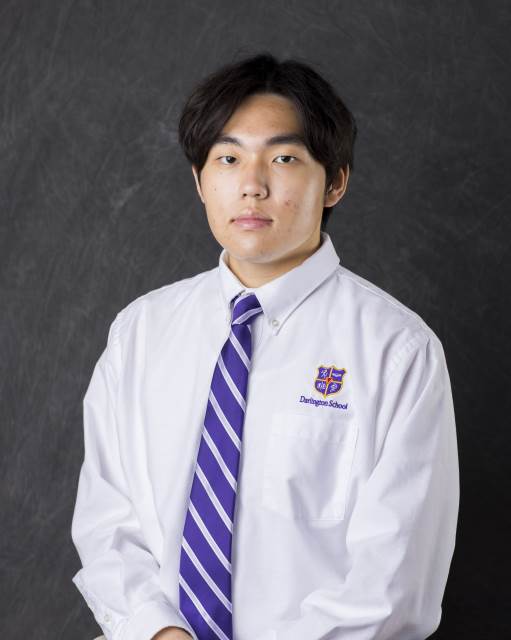
Chaebeom Lim ('27) was named a winner in the New York Times' multimedia contest by answering the question, "What’s it like to think, create, teach and learn at a time when artificial intelligence is transforming our world?" with an essay entitled, "The Tailbone of Thought." Over 2,500 high school students from around the world submitted multimedia responses to the question, and 35 were selected as winners.
Read Lim's essay below:
Why did the tailbone disappear? The tailbone was once essential, helping our ancestors balance and move. When we stopped needing it, evolution tucked it away, leaving a small reminder under the skin -a fossil of function. Lately, I wonder if the same could happen to thinking itself.
The first time ChatGPT went down, my cursor blinked like a quiet dare. I refreshed, checked another tab, refreshed again. And then an odd panic: Had part of my brain been outsourced without me noticing?
We've always made tools to push ourselves forward — the wheel, the printing press, the internet. But A.I. feels different because it doesn't just help; it finishes things for us. It guesses my next word, drafts my argument, even draws the picture I'm only half imagining. Each time I hand off the hardest part, I skip the friction that once built my mental calluses. And unused muscles, like tails, tend to shrink.
I saw it around me, too. My friends joked they couldn't write without A.I. anymore. Even one of my teachers said he couldn't finish grading without it. I laughed, then felt the joke land too close. When the struggle disappears, the tiny victories disappear with it — the late-night spark after a dozen wrong turns, the paragraph that finally clicks because you forced it to. Those moments don't just produce pages; they produce people.
This isn't an argument for smashing the machines. A.I. can be a brilliant mentor: a patient editor, a tireless tutor. The danger isn't the tool; it's how quietly it can become the thinker. If I never wrestle with a blank page, do I still know how? If my first draft is always partly borrowed, where does my voice learn its stride?
So I'm trying small acts of resistance. First drafts by hand. “No-A.I. hours” when I read slowly and let confusion stretch me instead of outsourcing it. A habit of leaving some roughness in my sentences so I remember they're mine. They take longer, but they make the work feel alive — like building muscle: sore, but satisfying.
The tailbone is still there, a minor bone that remembers movement. Maybe our capacity for deep thought can be like that — something we keep, even if the world tells us we don't need it. When A.I. hums beside me, I want to use it without letting it use me. I want to keep the part that struggles, questions and still believes effort matters. Because if thinking ever becomes a vestige, I'd rather be the odd creature who still knows how to balance.
Click here to view the other winning pieces.