
Total Eclipse of the First Day of School

By Jennifer Collins - FF/S
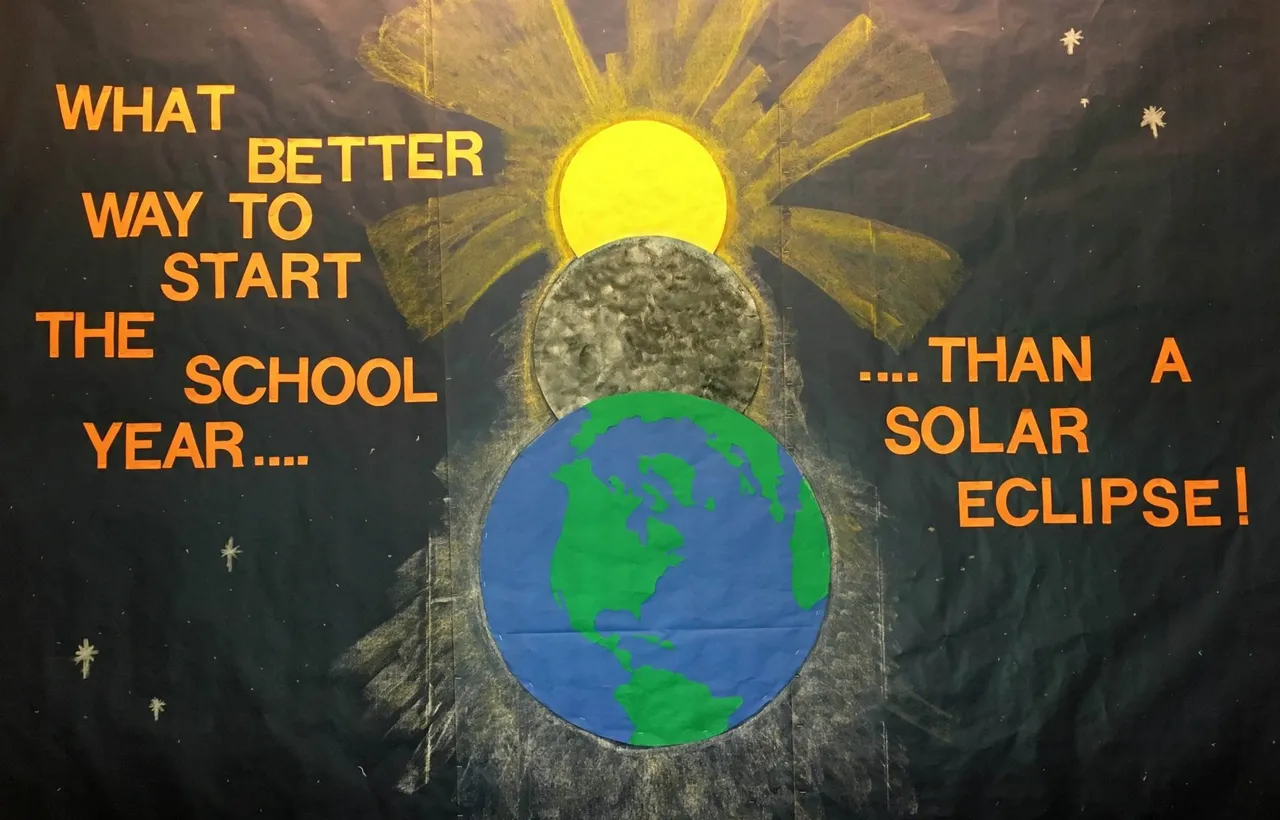
In just a few days, the United States will have the rare chance to witness a total solar eclipse. The last time a total eclipse passed from coast to coast in the U.S. was 1918, just 13 years after Darlington School was founded. The next one will be in 2024 and will have a much smaller path through the U.S.
This makes Monday’s eclipse likely a once-in-a-lifetime learning experience for children across the country. It also happens to be the first day of school at Darlington.
Things around here are going to be busy.
Our teachers have not only been preparing classrooms and campus spaces for the return of our amazing students, they have been preparing activities and events related to the solar eclipse that are guaranteed to set the tone for the entire school year. We have safe solar eclipse viewers for everyone, so it is bound to be enjoyed by everyone on campus.
Exploration. Creativity. Observation. Collaboration.
These themes and more are emerging from teachers that teach our youngest minds in pre-K all the way to our seniors.
I can’t way to see how the day will unfold.
Here are a few of the things that are planned for this amazing day:
Monday is a Tiger Day, and all students in Pre-K to 8 have been given eclipse T-shirts to wear for the occasion. Parents have been invited to join their children and starting at 2 p.m., pre-K to 5 will gather in the Johnson-Drummond Amphitheatre greenspace behind Thatcher Hall, while sixth- through eighth-graders will view the eclipse from Charlie Davidson Field, adjacent to the Morgan Pavilion.
To make the science behind the event accessible for young learners, McGraw Hill Education created a fun animation featuring the stars of eclipse: the one and only Moon, and her pal, Sun. Check it out here:
Pre-K to 2
Our pre-K through second-graders will be doing lots of fun activities and will be learning about what an eclipse is through art projects. Second-graders will be creating books that they will later share with the other students. Teachers have even come up with a great idea to protect young eyes!

Grades 3-5
Our third- through fifth-graders will be enjoying an exploratory time after lunch as they rotate through several stations on their hallway, learning about the science, math, and historical significance of this solar event.
“The old adage ‘seeing is believing’ will come into play on the first day of school when we all gather outside to see the partial eclipse,” said Alice Clements, science teacher. “Reading about it online and watching a video is one thing, but for students to have the opportunity to actually experience being outside during a partial eclipse is another level entirely. I know they will be buzzing with excitement afterwards and will be eager to learn more about what actually happened!”
Middle School
Sixth- through eighth-graders will be involved in full day of rotations where they will combine activities that help students get to know each other and their teachers along with some amazing stations related to the eclipse.
“In math students will learn about the phases of the moon and re-create a solar and lunar eclipse in the classroom,” said Chris Eberhart, middle grades math teacher. “Science teachers will utilize the power of Stellarium which shows a realistic sky in 3D, just like what a person would see with the naked eye, binoculars or a telescope. In English and history, students will learn about the mythology behind eclipses of the past and study about how the Babylonians reacted to it in their time. The art rotation features some great eclipse-themed music as well as an art project that will be turned into a mural to commemorate the historic event.”
Upper School
Upper School students will be involved in a number of team-building activities and orientation meetings. The Class of 2018 will be attending College Boot Camp throughout the day, too. At around 2 p.m. they will meet at Chris Hunter Stadium to few the eclipse together.
“While it is rare to see a solar eclipse, we are lucky to even live in a time where a solar eclipse is a possibility,” said Mike Hudson, Upper School science teacher. “At this moment in the history of the solar system, the size of the moon is almost exactly 400 times smaller than the sun's size and the distance the moon is from us is almost exactly 400 times closer than the distance the sun is from us. As a result, when you stand on Earth, the moon and sun appear to be almost the same size. That is the only reason this event creates such a unique show.
"Millions of years ago, the moon was closer to the Earth and the solar eclipses that the dinosaurs would have seen would have been the moon completely covering the sun (as opposed to fitting nearly perfectly over it)," he continued. "Over the coming tens of millions of years, the moon will slowly move further from the earth (at a rate about as fast as fingernails grow) and will cover less and less of the sun during a solar eclipse. Eventually, a solar eclipse will simply be a small dot of the moon passing across the sun.”
After School Plans
Pre-K to 8 dismissals will be delayed until 3:30 p.m. The gate around Thatcher Hall will be closed until 3:20 p.m. so that families can safely get to their vehicles after the eclipse. There will be no athletic practices after school for students in grades 6-8. The Upper School will maintain its normal schedule with release at 3:15 p.m. and athletic practices will be held as planned.
Great Eclipse Resources:
Eclipse NASA Website
NASA > Eclipse 101
NASA > Eclipse Livestream
NASA > Eclipse Art Projects
National Geographic > How to Photograph a Solar Eclipse
Free App > Totality By Big Kid Science (Third- through fifth-graders will be using this)