
NewsUpper SchoolStudent LifePre-K to 8Academics
Spanish Program heads students toward fluency
Jun 21, 2004 8:00 AM
By Stefan Eady - Faculty
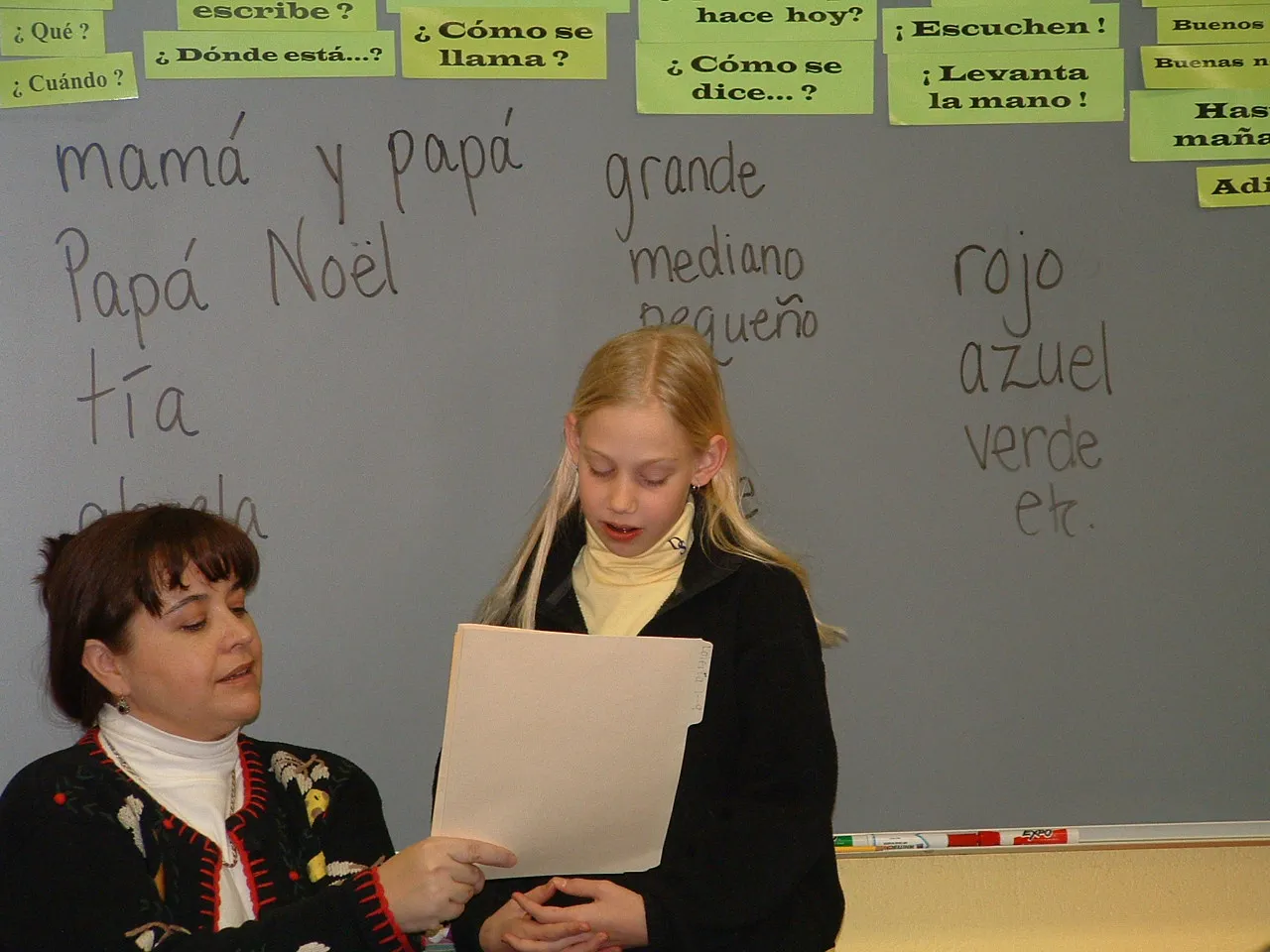
Five years ago, Darlington School added Spanish to its Lower School curriculum in hopes that all students who come through the Lower School would be fluent in Spanish and perhaps even in French by the time they graduate. Although a long-range goal that is four to five years away from being fully measurable, the School is well on its way to having its graduating class filled with bilingual students.
The Lower School Spanish program, which begins in pre-kindergarten, is primarily an immersion program in which students learn by speaking, writing and reading the language in 25-minute class sessions. Pre-kindergartners, kindergartners and pre-firsters have Spanish class twice each week, and students in grades one through five have it three times per week.
According to Barbara Barfield, Lower School Spanish teacher, the young children are at a perfect age to learn another language. “Research shows that the brain is much more capable of learning another language when the children are four, five or six years old,” she said. “Furthermore, if they begin to learn one foreign language at an early age, then a second or third language becomes much easier to learn in the future.
“For example, a student who begins in pre-kindergarten could take Spanish for 10 years – all the way through the eighth grade – and by that time be virtually fluent in the language,” continued Barfield. “That student could begin taking French in the ninth grade and by the time he graduates, he would be fluent in two languages. If you train the brain early for a foreign language, there’s a great opportunity for fluency.”
Carlos Ortega, chair of the foreign language department, acknowledged that the Lower School program will have a significant impact on the language program at the Upper School. “We have not seen the full impact of having Spanish in the Lower School because the first class that has had Spanish since pre-kindergarten has not come to the Middle School yet,” he explained. “However, in the five years that we have had Spanish in the Lower School, we have seen a tremendous difference not only in the knowledge of our students, but also in their desire and eagerness to learn Spanish.
“More than anything, they are not afraid of Spanish,” he said, “and they come with the preconceived notion that it is going to be fun and easy.”
Ortega’s assessment of the success of the Lower School program is exactly what Barfield experiences every single day with her students. “Younger children are much less inhibited and more willing to take risks,” she said. “The young kids eat the language up and have fun with it. They love to try to pronounce new words and because of the early brain training, most students have no problem pronouncing the words correctly.”
Barfield explained that the Spanish program at the Lower School does not use textbooks on any level. “They hear the language, and they read, write and speak it, all in a non-threatening environment,” she said. “What’s fascinating is that my students are learning to conjugate verbs and other structural concepts without even realizing they’re doing it. By immersing themselves in the language at the Lower School, they are going to find that when they have to learn the structure of the language in Middle School it will be much easier for them. They’ll be ready to take off.”
According to Ortega, the Lower School program has already changed the Middle and Upper School curriculum and staffing. “Now we have two full-time Spanish teachers in the Middle School and two sections of Spanish II classes,” he said. “Now most of the best students in the Spanish II and III Honors classes are students who come from our Middle School. In addition, since we have a number of freshmen taking Spanish II, we have added a course to our curriculum after AP Spanish; otherwise those students would not have another Spanish course to take.”
The Lower School Spanish program, which begins in pre-kindergarten, is primarily an immersion program in which students learn by speaking, writing and reading the language in 25-minute class sessions. Pre-kindergartners, kindergartners and pre-firsters have Spanish class twice each week, and students in grades one through five have it three times per week.
According to Barbara Barfield, Lower School Spanish teacher, the young children are at a perfect age to learn another language. “Research shows that the brain is much more capable of learning another language when the children are four, five or six years old,” she said. “Furthermore, if they begin to learn one foreign language at an early age, then a second or third language becomes much easier to learn in the future.
“For example, a student who begins in pre-kindergarten could take Spanish for 10 years – all the way through the eighth grade – and by that time be virtually fluent in the language,” continued Barfield. “That student could begin taking French in the ninth grade and by the time he graduates, he would be fluent in two languages. If you train the brain early for a foreign language, there’s a great opportunity for fluency.”
Carlos Ortega, chair of the foreign language department, acknowledged that the Lower School program will have a significant impact on the language program at the Upper School. “We have not seen the full impact of having Spanish in the Lower School because the first class that has had Spanish since pre-kindergarten has not come to the Middle School yet,” he explained. “However, in the five years that we have had Spanish in the Lower School, we have seen a tremendous difference not only in the knowledge of our students, but also in their desire and eagerness to learn Spanish.
“More than anything, they are not afraid of Spanish,” he said, “and they come with the preconceived notion that it is going to be fun and easy.”
Ortega’s assessment of the success of the Lower School program is exactly what Barfield experiences every single day with her students. “Younger children are much less inhibited and more willing to take risks,” she said. “The young kids eat the language up and have fun with it. They love to try to pronounce new words and because of the early brain training, most students have no problem pronouncing the words correctly.”
Barfield explained that the Spanish program at the Lower School does not use textbooks on any level. “They hear the language, and they read, write and speak it, all in a non-threatening environment,” she said. “What’s fascinating is that my students are learning to conjugate verbs and other structural concepts without even realizing they’re doing it. By immersing themselves in the language at the Lower School, they are going to find that when they have to learn the structure of the language in Middle School it will be much easier for them. They’ll be ready to take off.”
According to Ortega, the Lower School program has already changed the Middle and Upper School curriculum and staffing. “Now we have two full-time Spanish teachers in the Middle School and two sections of Spanish II classes,” he said. “Now most of the best students in the Spanish II and III Honors classes are students who come from our Middle School. In addition, since we have a number of freshmen taking Spanish II, we have added a course to our curriculum after AP Spanish; otherwise those students would not have another Spanish course to take.”