Reflections on a Presidency

By Stefan Eady - Faculty

It was the summer of 1979 when the Darlington community was buzzing with the news that James Park McCallie—of the renowned McCallie School family—had accepted the position as Darlington’s fifth president.
The Darlington Alumni Council thought the arrival of the McCallies presented a wonderful opportunity to introduce Jim and Nancy to Rome, so they decided to host a rousing barbecue reception. Darlington alumnus Jimmy Jones ’65 volunteered his cattle farm as the perfect location. The plans were made, the invitations mailed, and the responses came pouring in. The tables were set, the drinks iced down, the Brunswick stew cooked up. The cows got out.
By the time the cows could be herded to another pasture, the damage was done: spotting the landscape where the party was to be held were thousands of piles of fresh manure. Long-time Darlington veteran Gloria Eberhart remembers distinctly, “It was Jim and Nancy’s first official Darlington event, but everywhere you turned, there was a fresh pile of ‘fertilizer’ just waiting for someone to step right into.” Jim remembers with a big smile, “I guess all the Darlington folks wanted to give a McCallie a proper Darlington welcome!”
As it turned out, Jim’s early days were lean ones at Darlington. The boarding program was suffering. Faculty turnover was high and morale low. The campus buildings and grounds were in various states of disrepair and obsolescence. Financial resources were few, and the School was operating at a deficit. In fact, boarding schools across the country were struggling.
On this January afternoon, President Emeritus Jim McCallie reflects on his 21 years at Darlington, “the rise of private day schools caused many boarding schools to begin dying a slow death beginning in the early 1970s. Darlington would typically get students every year from Charlotte, Greenville, Columbus, etc., but as day schools increased in these and other areas, Darlington’s market for boarding students began drying up.”
Enrollment had declined in the 70s and the financial realities started sinking in, which ultimately lead to the merger of Darlington with Thornwood in 1973. But by Jim’s first summer, Darlington had still not fully resolved residual issues of the merger. “There were numerous challenges within the faculty and with the facilities. I remember I was helping out with admissions that first summer and was showing Trippeer Hall to a prospective girl and her family. We walked into the bathroom and urinals were still in there. The girl’s mother had no idea what they were and said, ‘Ooh, what are those?’ I told her, blushing, that they weren’t supposed to be there. This was just one example.”
Strategic Growth
If every dark cloud has a silver lining, then the changing boarding school demographics and impact of the merger on the faculty, facilities, and alumni gave Jim a clearer sense of what the direction he knew Darlington had to take. Jim and many others knew Darlington needed a “road map” for its future, so in 1983 close members of the Darlington community completed the School’s first Strategic Plan. The concept of strategic planning was relatively new to Darlington, but it proved to be exactly what the School needed at that time to give focus to specific ways for Darlington to grow and improve.
Jim remembers, “the most important thing that came out of that first strategic plan was the forming of the Board of Visitors. We had to come up with a way to tighten the relationship between the school and our emerging alumni and parent leaders, and the Board of Visitors was just a natural way to build these key relationships and get these people back on campus to really show them what a great school Darlington is. The creation of the Board of Visitors had as much to do with expanding Darlington’s influence as anything, and I credit that effort to having had as much to do with generating the Trustees that we have today.”
In addition to creating the Board of Visitors, Jim along with Dan Hanks ’27, Coit Troutman, and Gloria Eberhart, set out to reconnect with Darlington alumni. “I give Coit a lot of credit. He understood how important it was to cater to the alumni, and he was the one who really made me get out on the road. And Dan Hanks, whom I just absolutely loved and admired, and Gloria, Gloria was just invaluable.”
McCallie continues, “The value of those alumni gatherings, the increased focus on reunions, and the Board of Visitors really hit home to me very quickly. We knew we had to get out and spread the word. We knew we had to broaden the interest in Darlington. So as we did this, what began happening was that the boarding division started coming back.”
Jim and the Admissions team continued to strive for more exposure for Darlington’s boarding program. “We maximized our relationship with the Atlanta Boys Club. The New York Boys Club came in after that. The ARAMCO connection in Saudi Arabia was already in place, but that eventually lead to our relationship with ASSIST. Brad Gioia was just a marvelous director of admissions in the early 80s. He picked up on all of this and expanded our reach into Japan, as well. I soon had to move him over to work with Worth (Moser), but Brad was critical in expanding our boarding enrollment.”
Jim also worked hard to connect Darlington to Atlanta. “If Darlington was ever going to go anywhere, we had to really tighten up our relationship with Atlanta. And I give David Lacy ‘49 enormous amounts of credit for helping us back in the 1980s. Without David it would have been really tough for us to have made as much headway in trying to restore our relationship with our Atlanta alumni.”
The Board Emerges
As Darlington began building broader alumni relationships, the School began to feel the impact of alumni leadership, especially at the Board of Trustees level. Jim continues, stressing how his working relationship with the Darlington Board of Trustees facilitated so many of the positive changes in the School during his tenure, “the Board really came as a result of all this other activity. It was just a natural outgrowth. And it is incredible how the Board of Trustees has evolved over the past twenty years, and how they’re willing to work through the committee structure and handle so many things so wonderfully well, especially when you see boards from other schools that splinter and have factions, and start interfering in the internal workings of the school. I always felt like I was a pure partner with the Board of Trustees. There was never any ‘us and them’ relationship. Expectations were extremely high, but at the same time, the level of trust was just marvelous. There’s enough confidence that the School and the Board will handle things properly. I also think that having the ex-officio representatives from the Alumni and Parent Councils, Board of Visitors, and the Alumni Leadership Board have gone a hundred miles in helping communicate to these constituencies what’s going on at the Board level.”
Campaign for Darlington: $40 Million from $40 Thousand
In 1992, some 300 Darlington alumni, parents, faculty, and friends completed a new strategic plan for the School, A Vision for Darlington, which set forth goals and aspirations that if realized would take Darlington to even greater levels of pursuing its educational mission. To get there, it became abundantly clear that the School would have to conduct a major campaign, even greater than the Design for Darlington campaign, which had secured over $13 million from 1988-1992. The Campaign for Darlington was born and would prove to be most ambitious campaign in the School’s history and the crowning achievement of Jim McCallie’s presidency.
Jim McCallie reflects, “I spoke at an independent school conference recently, and the title of my talk was, How do you raise forty million dollars in a town of forty thousand? The answer is, of course, that you don’t. You can’t. You certainly have to do a good job on your home field, but you’ve got to maximize your ability to raise money out of that town of forty thousand. I think it’s one of the most incredible stories of how Darlington pulled that off.”
“I think we set the Campaign up right to start with. I thought that strategic plan was excellent. Everyone knew the Campaign was ambitious, but the needs were there, and everyone knew that too. The thing about Darlington is that once people agree on a certain path, you just don’t have many detractors out there. I just don’t know that we realize how tremendous that is, that once everybody has agreed on a course of action, everybody works towards making it possible. Its an incredible example of the Darlington culture. You’ve got terrific people sitting down planning things out and agreeing on what could possibly happen and then are willing to hang in there and stay the course to make it happen. Its just unbelievable that you would have a school this complex with so many demands on fundraising from so many different locations with such a small staff of people and volunteers that could pull off something of this magnitude. It’s mind-boggling. I think its one of the great stories. And people are asking me to tell them about it. And this what I’m doing to when I go to other schools now. And that’s what they want to hear. And I tell them the Darlington story.”
Jim continues, “The success of the Campaign was due to so many things. I think that there was a lot of good, solid thinking. We had to be smart. The needs were real, and I think everyone felt the School itself deserved it. And I think the faculty supported us. They didn’t let us down. From the internal standpoint, there was a terrific team effort. We had also communicated the needs of the School well, so most of our constituencies could appreciate and take interest in the goals of the Campaign, and the response by our donors was fabulous. And paramount was the great leadership. Look at what Billy Morris ‘52 and his team did. Incredible. Just incredible. Because there was no way Darlington could have raised $43 million without give and take and their willingness to work together to find a way to make this thing happen. I mean there’s just no way. These Campaign leaders, trustees, and volunteers were willing to give of their own efforts, money, and time way beyond what some of the them thought they were going to have to do, but I think deep down they realized when they first bought into the Campaign that it was Darlington’s big chance to be the School they wanted it to be. And that overrode everything, that commitment up front, and some how or another, we managed to do it. It’s just an incredible story.”
Leadership for the Future
When asked about leading Darlington into the future, Jim reflects, “There is a bulldog determination that’s behind Darlington. Starting with the era of Dr. Wilcox, Dr. Wright and Mr. Yankee, I think honestly it would have been awfully difficult to pull this off if I hadn’t been able to stay here as long as I did. It just takes a long time for a head of Darlington to get know everybody. And that’s why I hope David Hick’s will at least stay here ten years, because I think its gonna take that long to do another campaign to take Darlington to the top. I think were getting there in the South now, but to put Darlington on a strong national map, David needs to stay with it for ten years at least, and cultivate the people who can help him take us there.”
McCallie looks to the horizon and laughs as he remembers when he and Nancy were considering the move to Darlington. “I’ll never forget when Dr. Tom Harbin ’33, who led the search that brought me to the School, patted me on the back one day and said ‘Now Jim, if you come on up here and run this school, there’s one thing you won’t have to worry about. You won’t have to worry about any fundraising. We’ll take care of that for you.’”
The innocent irony of that memory immediately evokes Jim’s trademark smile, and suddenly we break into laughter. Looking back on his 21 years, Jim seems to take it all in stride. However his tenure began at Darlington, Jim recognized early on the great potential of this School. He found at Darlington a culture that matched his own genuine, unaffected manner, where the educational experience of the students—in all of its forms—was the first priority. He found a place rich in history, where teaching and learning were conducted in partnership. A place where students learned the intangible values of honor and respect. A place where young people were challenged and where growth followed. A place where bonds were made for life and lives were changed forever. And the good works he found here, he made better.
I am reminded of the saying that was a favorite of my grandfather, Darlington’s second president Dr. E. L. Wright: We build on the foundations we did not lay; we drink from the wells we did not dig. To Jim McCallie and the legacy of his presidency, all of us who care for Darlington owe a debt of gratitude for his determination, vision, and tireless efforts to strengthen our School to accomplish even greater things in the lives of the students who live, learn, and grow here. Jim McCallie has made Darlington better. Now, it is up to those of us who follow to build on his great works.
ALUMNI INSIDERS SPEAK OUT ON JIM MCCALLIE AND THE CAMPAIGN FOR DARLINGTON
Bob Glenn ’60 is the Director of the Corporate Syndicate Department at Robinson-Humphrey in Atlanta and a long-time Darlington trustee.
On Fundraising
From my perspective as an Atlanta alumnus, Jim McCallie seemed to be the person who came in and turned Darlington around. He identified that the School had to raise funds, and Jim’s fundraising abilities were extraordinary. I think his dedication to not only the School but also the School’s welling being was something that Darlington should be forever grateful. He was just tireless. He would turn over every stone. He built the endowment, built the library, up-graded the school, and improved the facilities, not to mention the new Huffman Athletic Center. Jim has a low-key confidence about him. He comes across as very sure that the money he is trying to raise is for a good purpose and that you are going to help better the world, so to speak, by giving money to Darlington. He does it in a very effortless, low-key style.
On Management
From where I stand, his ability to communicate with people, to surround himself with very capable and focused individuals, to manage the resources that he gathered in, and to involve key alumni in Darlington were among his greatest qualities. He made one or two mistakes, but everybody makes those in his life. The most glaring one was when he brought Roby Robinson ‘58 on the Board of Trustees.” (Laughter)
On Building for the Future
I think Darlington now has to be able to build an academic model that they can take initially around the southeast, but then nationally to attract students. And the model of the House System, from just the little I’ve heard, seems very interesting. It’s different. It’s challenging. The world’s changing and Darlington has got to change, too, but I still think Darlington is a hidden resource. What I hope David Hicks and his team will do is build the perception in Atlanta and other communities that Darlington is a serious academic boarding institution.
Dr. Bob Harbin ’67, a current parent, served with Jim as a longtime Trustee and as the Vice-Chair of the Campaign for Darlington.
On Leadership
If you look at what statistically Darlington accomplished during Jim’s 21-year tenure, it’s pretty phenomenal. Darlington came a long way. I’m convinced that leadership starts with one person. Now obviously Darlington has a great team of wonderful people, but one person had to be making the key decisions and the key moves to do what they did building up a development office and alumni centered programs. And boy it sure turned out to be the right thing. I mean, somebody was manipulating that school, and it had to be Jim McCallie to move in the right direction at the right time to do the right things. It sure paid off. It translated into a great success story.
On the Campaign
Much of what was achieved during the Campaign was due to work Jim and others did 15 or so years ago. I’ll never forget the day he came into the Development Committee meeting and said Billy Morris ‘52 had agreed to chair the Campaign. I said it’s going to happen. To have someone of that stature to take on a job like this at Darlington had really never been done before. David Lacey ‘49 had really carried the charge in the previous campaign, but to have somebody of Billy Morris’ position in the world to come in was a major break through and Jim McCallie did it in years and years and years of trying and never giving up.
On the Campaign Goal
I remember we were at one Trustee meeting and Roby Robinson ‘58 was talking about the “unofficial, unannounced campaign goal of $40 million.” Everybody was basically afraid to say it. It was such a massive figure that nobody could really conceive of it. We weren’t going to say that were not going to try for it, because your grasp seldom exceeds you reach. And we weren’t going to sell ourselves short. Nobody could believe it. And sure enough it happened.”
On Leadership Beyond Rome
I think another Jim McCallie initiative that contributed greatly to the Campaign’s success was a conscious effort, starting a number of years back, to involve more out of town alumni. And that was the key. There was a time period when it was just easy to just pick some folks from around Rome to be on the Board and not want to bother out of town people. But getting all of these out of town alumni back has been a major, in fact the major reason, that Darlington has been so successful. I remember John Thatcher ‘44 asked me “Aren’t y’all worried that these out-of-towners may come in and take control of your school away?” And my answer to that is “No.” The more successful people we get, whether they are out of town or not, the better. I’m not ever worried about that. Darlington needs the best talent it can get.
On Personal Motivations
I just always have felt strongly about Darlington. I would defy somebody to tell me a better institution to give your money to. Most people who are successful in life are going to make more money than they need to spend. And so most people, who are of good character, are going to give. So the question is where are you going to do it. Well you name me a better institution than that. The hard one that will come up with will be the church. And that’s a tough argument. My bias is towards Darlington. I consider Darlington to be Rome’s most unique asset. We have other good institutions, educational institutions, other industries, we’ve got a great medical community, but in terms of how everything ranks compared to their peers, I don’t think anybody is in a class with Darlington.
On Darlington’s Future
This Campaign has given Darlington the resources to do a lot more. One question we used to discuss was how many improvements could you make at Darlington that don’t cost money? There are some, but they are very few. Almost everything costs money. So, if you don’t have that base of support, you are limited as to what you can do. My view of the future is that its almost like the rate of change in the world is accelerating and this is somewhat unsettling. I feel great because we have David Hicks. David Hicks is such force, such an intellectual force, that I think that if anybody can make Darlington adapt and lead the way for what’s coming in the future he can. I think we are in great hands. Building from Jim’s leadership, I think David liked what he saw in terms of how the board interacted with each other, how they liked each other, how they got along with administration, and just a general feeling. You know, here was a bunch of people that care about a school and want to make it better. I think that had a lot to do with David coming to Darlington.”
Quill Healy ’56 is Chair of Marsh North America, Inc. headquartered in Atlanta. Quill is a Darlington Trustee and serves as Chair of the Development Committee of the Board.
On Jim’s Approach
The thing that strikes me the most about Jim McCallie is his great integrity, and you’ve got to start there. Whether you manage a school or a business, unless you have strong integrity the organization will not be successful. He has a low-key style, not really willing or interested in being pushy, but at the same time consistent with effort and enthusiasm, and always upbeat, always very positive about what he wanted to accomplish. I also think Jim had a very real sense of the importance of his colleagues at Darlington, a sense of the importance of the students at Darlington, and the type of experience that he was trying to provide them. Ultimately I think Jim built his vision of what he wanted to do with the School around these priorities, so Darlington could continue creating young leaders throughout the South and elsewhere.
On Jim’s Management
Jim laid down the foundation of a very solid school. He had gotten the finances in a firm position, much more so than they ever had been before. There’s a great old saying that you’re never too thin or never too rich. And so there will never be enough money to do all the things that you would like to do as a school. But in the Campaign Jim really did a great job in moving the School forward. I look at it very simply: You can’t have the programs, you can’t have the facilities, and you can’t attract the faculty unless you have the funds.
On Impressions of Darlington Today
I have enjoyed seeing the campus life and the enthusiasm that the students have and their bright faces. They seem to be focused on goals and on the colleges that they want to go to, and on the opportunities that they have in front of them. And I think that’s the biggest thing about Darlington for the kids that are there today: that there is the combination of the dorm and day life and connection with the faculty, all within a community or family setting, where you build some very close bonds with the people that share the same experience. It becomes an instrumental part of your life. The educational experience becomes the Darlington experience.
On Looking Forward
One of the key defining elements of Jim McCallie’s legacy will be Darlington School with greater resources and better positioned to advance its total educational program in the future under David Hick’s leadership. I think the House System, which is David Hicks’ major contribution thus far, is creating something really new and different from just simply rearranging the deck chairs on the Titanic. Darlington is obviously in great shape from the day students, but the boarders create the difference, yet we don’t have the endowment that we would like, even though we are a lot better off than we were. With an increased endowment, we wouldn’t have to have the tuition as high, which probably would make us more attractive to a greater number of families. And so we really need the resources to build the endowment going forward.
But clearly Jim moved the school to a very solid foundation, both academically and financially, where it was then ready for David Hicks to take it to the next level. And hopefully the next level will come out of the housing concept, so we’ll see what happens.
Gordon Lee Hight II ’62 is a longtime Trustee of Darlington and was Chair of the Board during the early days of the Campaign as well as an active Campaign volunteer. Gordon Lee also led the strategic planning effort that produced A Vision for Darlington.
On the Board of Trustees
I will always consider myself to have been very fortunate to have served in the Board Chair capacity while Jim was president of the school. It was a rich and delightful association for me in that role. I believe that if Trustees are smart, they won’t try to run the school. They will employ somebody to do it and their lives will be much richer for it. Jim executed his office in a very dutiful way. Unlike so many schools where the Board is meddling and dominating, we were able to build during the 90s an even better Board that spent its time, attention, and energy dealing with what we could do to help the school rather than what we could do to dominate the school. That would not have been possible without someone like Jim, of which there are a precious few.
Board building is one of the essentials to a successful capital campaign. What went on during the entirety of Jim’s administration was a gradual evolution of our Board toward being one which came from our constituency worldwide, which is where our alumni are, rather than just Rome and Floyd County. So we have really empowered the school by involving a number very capable and caring people from outside of our immediate area. That’s something that we are going to have to continue to work on. You have to nurture and continually renew a board or it will fade.
On Jim’s Personal Manner
Jim is a man deeply aware of his opportunity in life to leave things better than he found them. He’s a profoundly patient man, he couldn’t have achieved what he did without being patient, including tolerance of some who, however well meaning, didn’t understand the school business as well as they might have had they spent a career in it. Jim is also a man of great vision. He develops his own concept of where the institution should be going and then helps others to discover the virtues of his view. And he is patient enough to wait until they do. Jim McCallie is usually right. It just takes some of us a little while to come around to fully appreciating that he is.
On Jim’s Presidency
Jim McCallie’s responsibility was to cause the institution to promote what I think of as a laboratory in which great teachers can practice their craft. Jim saw to it that one way or another the resources were made available and good people were attracted here. It was through the works of those good people that Jim’s own hand accomplished the great and many good things in the lives of young people that were achieved during his years.
On Personal Motivations
In my life Darlington has represented a most substantial blessing. It has been for me a vehicle in which to engage myself in efforts that hopefully have touched the lives of young people in a beneficial way. It is a place where I knew love when I was a student. I feel this is something that we should be sure to preserve and protect and build on. The way the school administration has supported its volunteers (standards of support set by Dan Hanks and Gloria Eberhart) has always made it a treat, and an exciting joy to be involved with the School. So, I keep coming back. They haven’t been able to get rid of me yet.
George Johnson ’54 is a Darlington Trustee and active Development Committee member who has recently served as Vice-Chair of the Board.
On Jim McCallie
The most impressive thing to me is Jim’s honest demeanor, his humility and good judgment and wonderful ability to make fun of himself. He is so humble and self-effacing that it takes you a while to realize how smart he is. This fact coupled with his low-key nature makes it hard to see him coming. He sneaks up on you. But Jim is such a nice person, I was always happy to see him. Jim has a wonderful ability to connect with people. He also has a great ability to connect the right people together. I turned Jim down three times before I agreed to join the Board. His persistence changed my mind. He developed a relationship with me.
Jim and Nancy represented Darlington in such a wonderful and professional way for 21 years. They made us all feel proud to be a part of the Darlington family.
On the Campaign
I’ve been involved in a number of significant campaigns, but I don’t think I’ve ever been involved in one where so many key people cared for the institution so deeply. All the trustee leaders and major donors truly loved Darlington, so when a few stepped up to make gifts, others joined in, and in the end, everyone enjoyed giving to the School because Darlington means so much. Jim McCallie’s role in convincing Billy Morris ‘52 to be the Chair of the Campaign was the key to its success. Billy became an inspiration to us all, and along with Jim and John Thatcher ’44, led us to victory.
Jim Paved the Way
In the presidential search process, Jim McCallie was extremely important in the selection of David Hicks. Jim actually paved the way for Darlington’s future. His management of the School created a climate and culture that made Darlington attractive to David Hicks. Jim did a wonderful job of paying attention to alumni and the trustees.
With David’s leadership in the next five years, along with that of the outstanding faculty and staff at Darlington, I think Darlington could rank as one of the best boarding schools in the country. We will continue to have a strong day division, but with the new House System, which I think is brilliant, Darlington’s boarding program could emerge as one of the strongest in the country. I really believe great things lie ahead for Darlington.
Billy Morris ’52 is a current Darlington Trustee and served as the Chair of the Campaign for Darlington.
On Jim’s Tenacity
Jim was a very fine leader. He is not one to pound the table, but he leads by example and persistence. He is highly focused and never gives up. After Jim and Billy Dupre ‘51 came over to see me about heading up the Campaign, I really got to know Jim better. During the design and strategic planning of the Campaign we worked very closely together. Subsequently, I made a lot of trips with him to call on alumni and friends of the School. And I’ve never seen anyone more focused on accomplishing a mission than Jim. He would never let us give up. There were times when it was very discouraging. We would get turned down, but Jim would never take anything personally. He would just keep on asking, keep on persevering, and keep on trying. He never gave up. That was the great quality about him, that I found to be so wonderful.
On Jim and the Campaign
Jim very much wanted to successfully complete the Campaign. It was to be his last act as president. And Jim came from people that knew the value of independent education. So he had a great appreciation for the importance of independent schools and was committed to improving Darlington. Jim recognized the great needs we had at Darlington, and we really had a lot of needs and still do, but we’ve fixed some of them. Jim kept us all focused on the dreams and the visions of what this Campaign could do for Darlington. We raised more money than anyone ever thought we were going to raise. As I have said, the success of this Campaign really goes to Jim, because he was the guy that wouldn’t quit, he wouldn’t take no, he kept on going, whether he would be turned down here, or the door would close there, he’d figure out another way to get in.
On Darlington and Its Personal Impact
Darlington made a major impact on my personal life, and I don’t believe I would be where I am today were it not for that experience. I was not doing well here in Augusta and my parents recognized that and sent me to Darlington. At the time I didn’t want to go. But, as it turned out, I needed exactly what Darlington offered for a young boy. I needed a structured environment, with people who cared about me, and who were not going to let me fail, but were going to stay with me, and keep me focused, and keep me encouraged, and take the other things out of my life that were diverting me. That’s what Darlington did for me. And I will always remember that, and be grateful. If it hadn’t been for my days at Darlington, I’m not sure I would have made it. I had a real turn around experience, which was a major, major point in my life.
Putting Something Back
Before I agreed to chair the Campaign, I had never done anything for Darlington that I felt was important. I had given Darlington some money along the way, and done a few other things, but I hadn’t been all that active even when my son Will ’79 went there. Along with my sister Alden (Maier), the Morris family has had 8 or 9 people that have been touched by Darlington in one way or another. Either they have been students there, or in the case of Steve Parsons, a former faculty member. I have a philosophy that I like to put something back. So it’s just seemed to be the thing to do. But I was glad to do it. And I felt very good in the way the Campaign ended, and it did some things that simply had to be done at Darlington. The endowment had to be strengthened and the new athletic center had to be built. The infrastructure had to be repaired. I mean we just had a lot of things like that that had to be done.
On the Importance of Endowment
If you compare Darlington’s endowment with other schools of like age, we are way, way behind. Darlington is a school that is about to be one hundred years old. And we need a hundred million of endowment. We’ve got twenty-one million or so now, so building our endowment must continue to be a priority.
The Importance of Alumni
A bigger asset than just raising the money for the Campaign is the re-attachment of so many alumni to the School, including my own re-attachment. We had people come back that hadn’t been back for fifty years. We threw a wide loop for the Campaign Committee. Almost everyone, except for two or three people that had health problems, accepted. We introduced people of different class years to each other that had never known one another. I made several wonderful new friends with people who had gone to Darlington that were not in my class and that I would never have known them otherwise.
And we worked together, and brought a spirit of camaraderie into the greater Darlington family. So I think the greatest benefit that the Campaign had was not the money, but was the awareness that we brought to the minds of our alumni, and the re-attachments to the School that occurred in that process.
Aspirations for Education at Darlington
Darlington needs to continue to provide a quality education, in a structured environment, for men and women who desire and need that kind of program. Not everybody does. And not everybody can afford it. We give a number of scholarships now, which allows us to balance out our student body, which we should. We don’t want Darlington to ever be just a rich man’s school. And its good to have a scholastic program where people can qualify for these scholarships who come from families of lesser means, or who have had lesser opportunities. So we always want to make sure that we keep a balanced mix at Darlington so we can continue to increase the quality of education and the richness of the experience.
Darlington needs to function primarily a boarding school, while maintaining our strong day school. But education is the key to the whole thing, and not everybody needs exactly the same kind of education. Public schools are fine for some people. Private schools are fine for other people. Some girls need an all girls’ school. Some boys need an all boys’ school. Some people need a co-educational school.
The diversity and the greatness of our nation, is that we can offer all these kinds of things. And we can do it a competitive environment, so as they are all attached to each other, and compete with each other, and connect with each other, and enrich each other, because they’re all trying to get better. So, Darlington has a definite niche, a definite role to play, and it needs to stay focused on its mission, but always have high quality as its goal.
Looking Forward
The momentum that Jim McCallie created at Darlington, the trend of the School, had a lot to do with attracting David Hicks, I’m sure. You want to go to something that’s on the move. You don’t want to go to something that’s flat or declining. So I’m sure Darlington’s health and momentum had a lot to do with attracting David.
And I think we looked over the country and found the best candidate for Darlington School at this point in its history. I must say now that I have met David, and have had some time with him, and have watched him come in and take over and get started, I am very gratified with with the job that he is doing. He has a great amount of experience in secondary education. He understands what the mission is. He is in sync with the Board and alumni, and so I am looking for a great era under David Hicks.
Roby Robinson ’58 is the recently retired President of Robinson-Humphrey Company in Atlanta. Roby was the Vice-Chair of the Campaign for Darlington and will be rejoining Darlington Board of Trustees as the vice chair.
On Jim’s Personal Style
Jim is a thoughtful, warm, educator and leader. He has a very gentle demeanor, and yet a very quiet strength and firmness behind him that keeps him moving towards whatever his goals may be. Jim is not someone who in crowd would come across as loud or outspoken in anyway. He’s not someone that would stand out as the ‘life of the party’ or whatever. He impresses me as someone who is very precise, firm. I’ve never gotten the sense that he’s ever really totally unsure about anything. I get the sense that he’s thought about it, and sort of mapped it out—not that he’s immovable or unchangeable—but that he has thought about a particular direction and committed himself to it, and is pressing on. At the same time he strives for, and has the ability to build, consensus.
On the Board of Visitors
It was Jim’s vision to create the Board of Visitors, which gave people a chance to learn what was going on at the School. We weren’t going to ask them to do any heavy lifting, but to come back to Darlington and see what we were doing and get involved. I credit Jim because I think he realized very early on that one of the strengths of the school was its diversity. And diversity meant that you had to have a strong boarding program. To get a strong boarding program you can’t just draw from the city of Atlanta, but you had to reach out to alumni in Kentucky, Alabama, South Carolina, or wherever and get people involved from that sense. And as word would spread it would help build the boarding program. Further, as the campus infrastructure began to disintegrate, having the involvement of people from outside of Rome and Floyd County was crucial. Jim is the one that I see as captain of the ship and I think it was his vision that got Darlington to sail from one shore to the other.
On Atlanta Alumni
I think Atlanta’s alumni leadership is critical to Darlington’s future quite frankly. Darlington is the only boarding school of its kind left in Georgia. It must continue forward as a boarding school. And so I think that Atlanta is critical to that process because of the population base and the diversity of the population. I think its essential that we help the school cultivate the next round of fundraisers and the next round of loyalists, if you will. We need to find people who are graduates, ten years ago, fifteen years ago. Half of what we are. If the love and strength in Atlanta for Darlington is going to continue we have got to cultivate these people and get them into the process of greater interest and involvement in Darlington and her future.
Remembering the Campaign
Jim is tenacious. But, gently and quietly so. He really won’t take no for an answer. I know personally, because I told him no, no, no, for about five or six months in terms of taking a leadership role in the Campaign to head up the Atlanta effort. And, repeatedly he just kept coming back, and coming back, and I guess in his own way he wears you down. But in a nice way he wears you down.
This persistence defined his approach to the Campaign. There were times when a lot of difficult issues arose that Jim provided the overall direction and made sure we kept the wheels on the track. At one point I thought the wheels had almost stopped turning and that we had almost run out of gas, but Jim was the one who kept filling up the tank and kept pushing for the higher goal. And as we went along, we knew that inflation was pushing the costs up, and it was like we could never quite grab the ball. We could touch it, but then it would roll one more time. So I think Jim’s great strength was that his resolve to stay the course imbued others with the same spirit, to not settle with half the load, but to stay with the goal, and keep fighting the fight. So many of us had heard Jim ‘talk the talk’ for so long that we were willing to ‘walking the walk.’
Pride of Success
As I have said, I attribute the Campaign’s success to Jim’s persistence and drive, his refusal to let the team fade, and his demanding more. We who worked so closely together on this effort are extremely proud when we talk to people. For a secondary school, for us to be able to say to our friends we just raised $42 million, jaws fall. I mean, they really go slack jawed. One, it instills great pride. Two, it creates a bar for the next time around. And when the Board of Trustees decides its time for the next campaign for whatever purpose, I think there will be a greater feeling or sense on the part of those asked to lead the effort that it can be done.
On My Days as a Darlington Student
I think in many respects, Darlington really saved me and put me on the right track in terms of my quest for education and knowledge. Darlington saved me and helped me avoid the many pitfalls I had made in Atlanta and would have continued to make, and Jim to me sort of embodied all the qualities of the people that I most respected and admired, like the quiet strength of a Bull Yankee. To me Jim personified all those things that were so important to me the four years I was there, the knowledge, the wisdom, the leadership, and he was the one that really kind of hooked me back in to Darlington.
On Jim’s Retirement
Jim made the decision to retire in his own right, I think, seeing the Campaign as the culmination of his efforts that had begun twenty years prior to that. And I believe Jim’s passing of the torch was one of the most gracious and selfless that I have ever seen anywhere. My perception is that Jim could probably have stayed longer, but he saw it was time for someone who could re-kindle the fire and get it burning hot and heavy, and come in with fresh ideas and take Darlington to the next level.
I think David Hicks feels the fire in his belly and has fresh ideas to take what Jim made and build on it. Like Jim, I perceive David to be a consensus builder and a listener, but perhaps with a different style and approach, but I think he’s the right man at the right time. When a new quarterback comes in he has to build a sense of loyalty and a sense of his own involvement with the team. He’s got to sell himself to the people there, and convince them that he can do the job to win their support. And I think David in very short order has done that.
John Thatcher ’44 is a longtime Darlington Trustee and served as the Chair of the Board during the final three years of the Campaign.
On Jim’s Personal Approach
Jim was always an optimist, no matter how bleak the picture looked…He was always smiling about what could be done. He makes you believe that we are going to achieve success. Jim also has a great ability to ask others for their support. He approaches people in a way that makes them want to respond affirmatively. It is hard to turn Jim down. Even so, I’ll never forget the time during the Campaign when a major pledge had to be withdrawn. It was very discouraging to all of us, particularly due to the size of the Campaign goal we were considering, but Jim didn’t let this de-rail him, nor would he let it de-rail us.
On the Campaign for Darlington
The Campaign for Darlington was such an ambitious campaign: the goals were high, well beyond anything Darlington had tried in the past, but I think since it was based on serious needs for the School, and not based on things that would be nice to have, there was a chance for success. It was key that Jim was able to secure initial pledges. He showed a dogged determination to keep fighting for our goal, because they were about needs. We faced numerous pressures to reduce the goal, but Jim worked hard to keep everyone focused on Darlington’s great needs; and people responded; they got on board, and as the enthusiasm built, more and more significant pledges started coming in, and slowly we started inching closer to our goal. Campaign Chair Billy Morris ‘52 and the development staff also stuck to the goal and held it firm until the very end. But all through the Campaign, I never saw Jim discouraged or open to settling for anything less than the entire goal. I continue to be impressed by Jim’s tenacity and calm faith that Darlington community would come through, and it did. For a small community like Darlington’s to have raised more money than any other day/boarding school in the south is a strong reflection of the Darlington community and the great volunteer leadership under Jim McCallie’s presidency.
On the Board of Trustees
During the Campaign for Darlington, I was greatly impressed with the strength of the Board of Trustees. I think the Board made a strong symbolic statement for all alumni about the importance of investing in Darlington to support the future of this great place.
Darlington is a light in the darkness of this world where students can come away instilled with values, with a foundation to build a successful life for yourself. Darlington is so different than what is happening in most other educational environments. Our School doesn’t shy away or avoid, but embraces the teaching of values. In encouraging alumni to support Darlington, the Board of Trustees through their example has made it clear that investing in Darlington’s value system is up to all of us who care for our School and its future.
On Why He Serves Darlington
Reflecting on my own Darlington experience, I was one of the most homesick kids that ever came to this School. Looking back, my coming here was one of the most important decisions my parents ever made for me, since I wasn’t achieving academically at home. Darlington became a new twist and had a significant impact on my future, preparing me for college work at Davidson. The self-discipline I learned from my Darlington experience not only helped prepare me for college, but also for my business and personal lives. All my successes have been built on the foundation I received at Darlington. So when you look back and see that the School was so influential on your life, you have to, I think, express your appreciation through giving back. Going forward, Darlington is poised to be an even more exceptional school than it is now. We have a great faculty and staff, one of the most beautiful campuses, a great reputation, a quality culture based on honor and strong Christian values, and a constituency who loves the School and wants to see her become the best school in America.
Larry Williams ’67 is the former Treasurer of the Board and Vice-Chair of the Campaign. Larry and his classmates and fellow Trustees Wilkie Colyer ’67 and Bill Holmes ’67 lead the way for their class to name the new athletic center in memory of their classmate A. J. “Butch” Huffman ’67.
On Jim McCallie
Jim McCallie’s fabulous ability to recruit key members of the Darlington family, primarily alumni, and keep them energized over a seven-year period of time I think has got to be the greatest tribute to his leadership. His ability to engineer the solicitation process in my mind was perhaps his greatest gift to this campaign. Jim would always get the right person to go.
McCallie as Campaign Engineer
We were probably three years into the campaign. We were at Robinson-Humphrey and we were having a meeting, and the challenge was that things were not going so hot. And the question was how do we jump-start the campaign from here? And it was the usual suspects, there was Bob Glenn ‘60, and George Johnson ‘54, Quill Healy ‘56, Billy Morris ‘52, and Roby Robinson ‘58 and we were gathered there. And we went through the meeting and you could tell that none of the people were enthusiastic and something needed to happen. I had had about 3 or 4 cups of coffee, and so I had to take a break to go to the men’s room and I when I returned, Jim and Roby were the only guys left in the room and they were clapping. And I said, ‘excuse me what’s the deal?’ And they say, ‘well, we just want to thank you for what you’re about to do.’ So I looked at them and said, ‘What are y’all talking about?’ to which they replied, ‘well, Larry, we’ve thought about it, and you’re the guy we want to run the Student Athletic and Recreation Center campaign.’ I said ‘you got to be kidding! I just went to the bathroom! How’d this happen?’ And Roby looked at me and said ‘Williams that’ll teach you, don’t ever leave a meeting until it’s really over.’ And I remember that so well. I was so shocked I couldn’t even talk, which is a rare occasion for me. And so I listened to them and they laid it out, and Jim McCallie had once again engineered a solution, a way to not only solve the problem, but also to re-energize a portion of the Campaign. In retrospect it was brilliant, because it allowed a more narrow focus. It allowed people to really get involved and concentrate on the athletic center, and what eventually came out of that were additional financial commitments and successful solicitation efforts. Again, Jim McCallie was always lifting the bar higher than a lot of us thought we could achieve. He was just a masterful campaign engineer. ”
Motivations for Involvement
My original commitment was to endowment, because I was the beneficiary of seven years of scholarship money at Darlington. I represented the product of that investment, and I intended to prove both financially and through my commitment to the Campaign, from a time standpoint, to show that this investment was going to pay off for Darlington School. And I was really interested in doing what I could for people like me that could not have afforded to come to Darlington otherwise, to be given that chance. And so I gave a testimonial of sorts to the Trustees, and endowment for tuition assistance became my banner. I was hell-bent on raising money for endowment to further scholarships and financial assistance to deserving students. This was early in the Campaign, prior to the formation of the athletic center team when I was asked to lead that effort. But my interest was that Darlington School had made an investment in me on the one hand, and on the second hand it was easily the most meaningful experience in my formative years, in many ways. I don’t know whether it was the collegiality of the school, the friendships, the institution itself, what I learned, the opportunities that it created for me by being there, or the fact that I had performed well academically. Darlington was an environment that allowed me to mature, develop, and excel in a number of areas, both from a competitive as well as a personal standpoint. And so it was an easy thing for me to want to get involved.
Darlington in the 60s
Whenever you’re talking about the ambiance, the culture, the platform, or the facilitating experience, I don’t think you could say it was any one thing. There were a lot of things going on at Darlington and it all sort of worked. The longevity of tenure was important. The teachers we had at Darlington were almost iconoclastic. I go back to Mr. Judd, Worth Moser, Jack Dorminey, Jack Barkell, Hugh Mercer, Dick Yankee, men that had been there twenty, thirty, forty years. These were not autocratic type teachers. The vast majority were people that really got excited about their subjects and pushed you to the edge. Darlington was a fun place to learn. So the tradition of Darlington School was certainly part of it. Darlington was a very collegial environment where people were excited about everyone doing well across a broad number of areas.
Steady as She Goes
I have so many fond memories of Jim McCallie that it’s hard to single one out. I almost felt like he was the admiral of the ship. When the ship was in rocky waters, he was cool. When things were going really well, as excited as he was, he was ‘steady as she goes.’ Jim had some very rough times at Darlington, but he never let them rattle him. So you got to the point where you had a lot of comfort with Jim the helm, because you knew he wasn’t going to get ruffled one way or another. And so if I had one thing to say about Jim McCallie, he was just a very ‘steady as she goes’ sort of guy who manned the helm with a great ability to build consensus, yet make decisions. In many ways for where Darlington was at that time, I don’t think you could have had a better skipper.
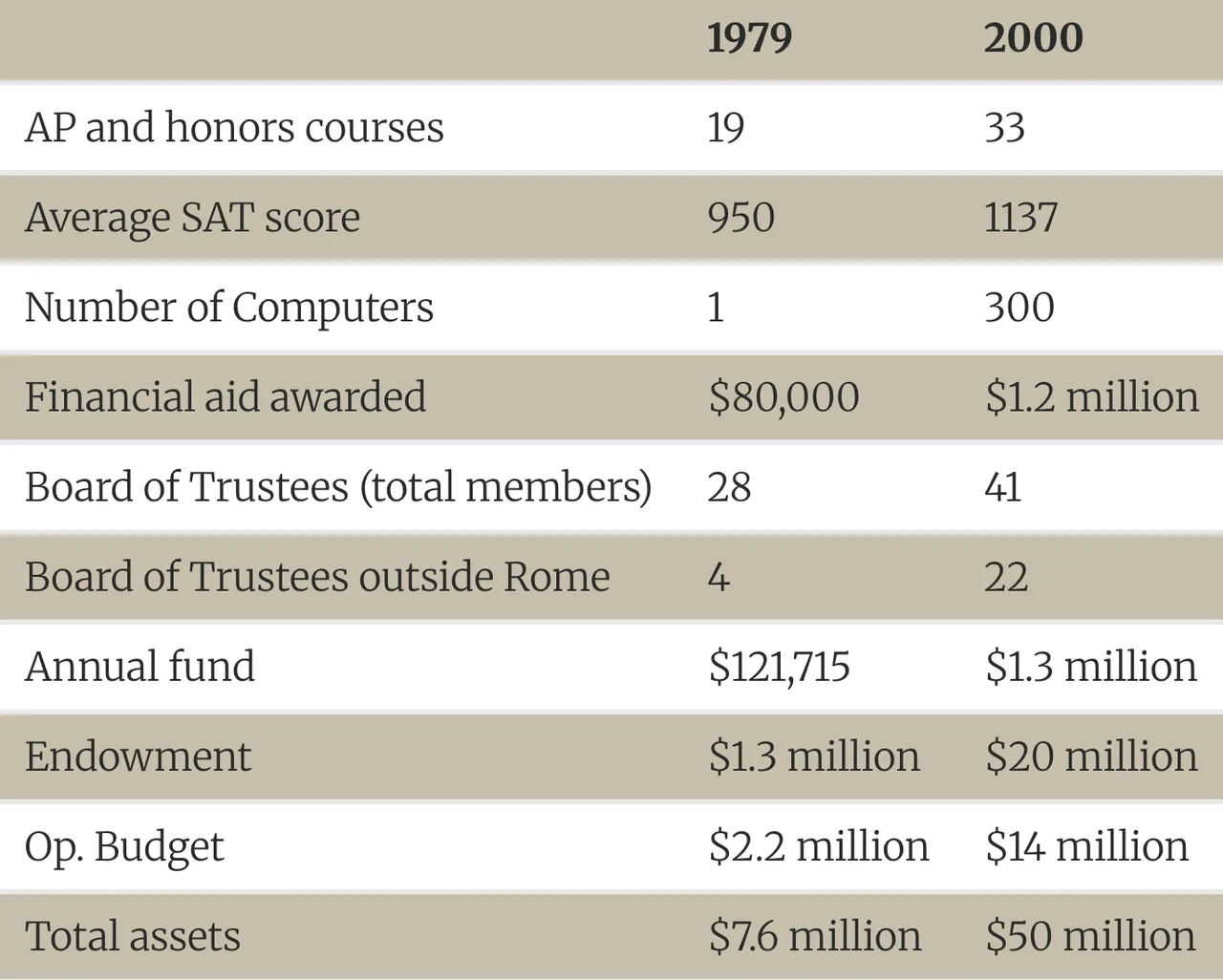
Since Jim McCallie became president of Darlington School in 1979, the school has grown in numerous ways. Below are but a few examples of the improvements made during Jim’s presidency.