NewsStudent LifeFaculty/StaffAlumniPre-K to 8AdvancementServiceAcademics
Optimist Club selects winning speeches
Feb 24, 2004 8:00 AM
By Stefan Eady - Faculty
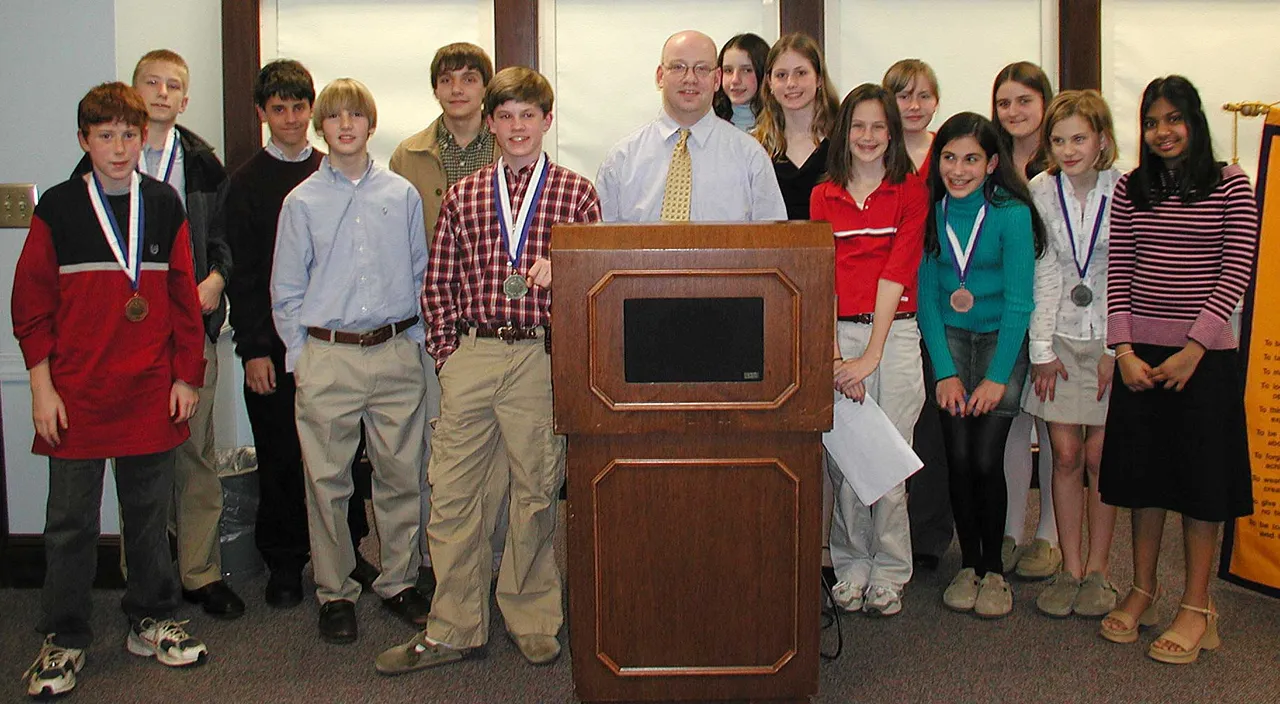
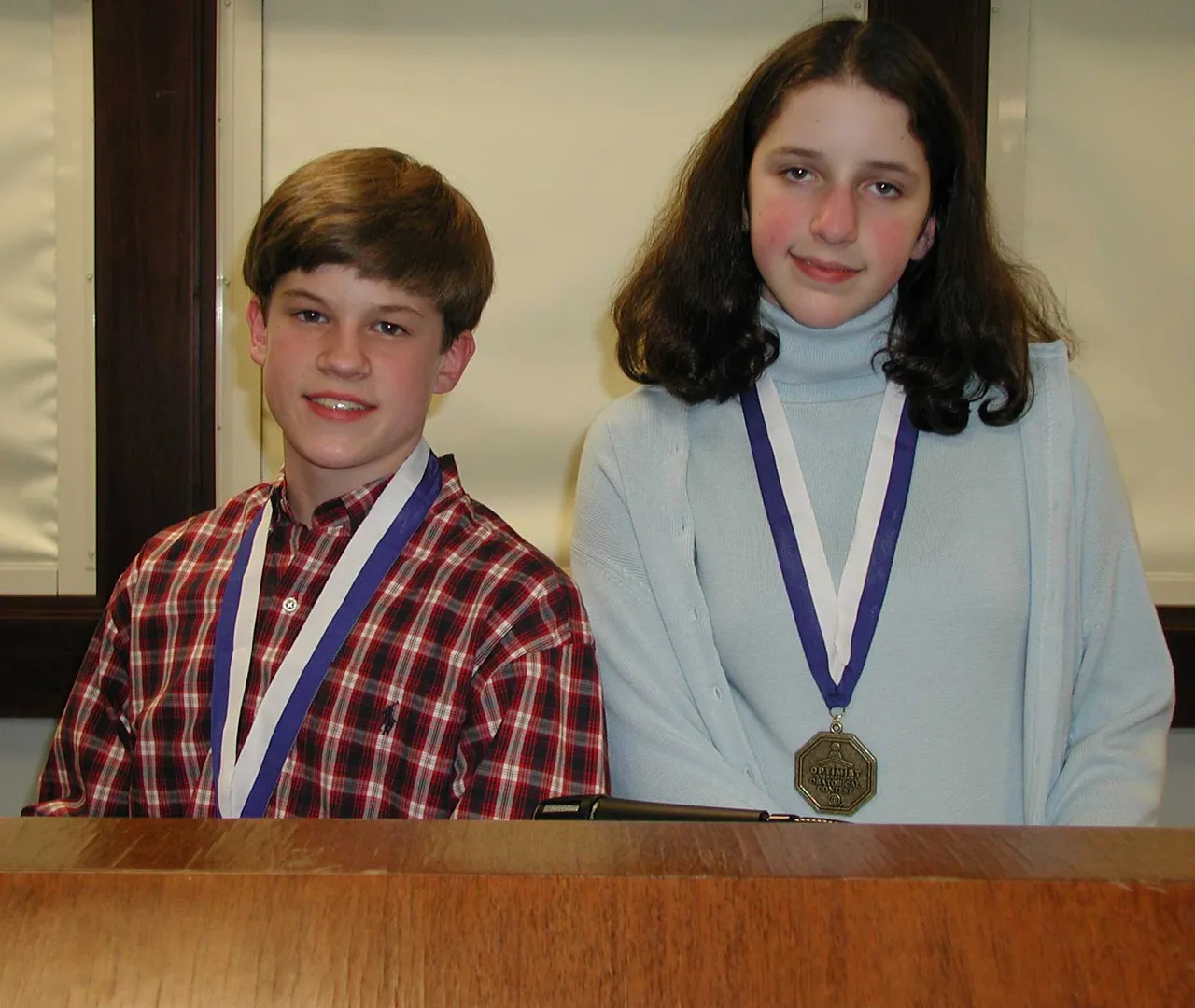
Seventh grade students Alexandra Dodd, daughter of Julia and Gayland Dodd, and Jett Puckett, son of Joy and Jett Puckett, all of Rome, Ga., won first place in the club’s Optimist International Oratorical Contest held in mid-February. Second place winners were seventh graders Isabel Bonnyman and Alex Purdie, and third place winners were Grier Fricks, eighth grade, and Adam Troy, sixth grade.
Other participants in the competition were sixth grader Emily Braden, seventh graders Sharpe Sablon, Ian McKenzie, Patrick Pierson, Anisha Chandra, and Nastassia Bryant, and eighth graders Starla Brumit and Jennifer Watford.
Middle School students wrote essays in English classes, and those who entered the contest developed their essays into speeches. The two first-place winners go on to zone level competition the week of March 21 at the Rome City Board of Education.
First-place winner essays follow:
Thinking, Working, and Expecting the Best
By Alexandra Dodd
”We the people of the United States, in order to form a more perfect Union, establish Justice, insure domestic Tranquility, provide for the common defense, promote general Welfare, and secure the Blessing of Liberty to ourselves and our Posterity, do ordain and establish this constitution for the United States of America.” – U.S. Constitution
“Four score and seven years ago our fathers brought forth on this continent a new nation, conceived in Liberty, and dedicated to the proposition that all men are created equal.” – Abraham Lincoln
“Ask not what your country can do for you, ask what you can do for your country.” – John F. Kennedy
These famous quotes from Abraham Lincoln, our Founding Fathers, and John F. Kennedy were brought forth to motivate Americans to improve their country, hence improving their lives. They had to think and dream about what they wanted this nation to become. They set goals and resolutions for the people and the future generations of America. The goals had to be high but also have a good sense of reality to them.
The Preamble, or introduction to the Constitution, tells the purpose of the Constitution and what is expected of the newly created America. Although it is only one sentence, it lists the ideas that form the basis of a great country: Tranquility, Safety, and Liberty. Attaining these high ideals was not easy, but the founding fathers devoted their time to making them a reality for this country. At the close of the Civil War, President Abraham Lincoln sought to mend the wounds of the divided nation. He reminded the people of these same principles on which our country had been founded. A youthful president Kennedy encouraged all Americans to contribute to the betterment of their society, rather than always receiving benefits provided by a wealthy nation.
I believe that the thoughts, work, and dreams of these distinguished Americans have great relevance today. Our thoughts and actions can and will enable us to reach our goals.
At school we are presented with new challenges every day. WE have to think and work our way through them. To learn new things students need to think about what they are doing and trying to learn. We have to know that we are capable of great things. In the workplace, it is just as hard. We must make a good impression on everyone we meet, because we never know how that person might play a role in our life. Added to this is the stress of everyday life. However, if we think positively we will be able to catch up with all we need to do. We must be willing to do the things we have to do.
In the present, as students, and in our future careers and endeavors, we must not only aim high and think big, but also prepare ourselves to optimistically meet the challenges that accompany great expectations.
By Jett Puckett
I believe optimism is a big key to success, in an area whether it is academics, sports, or your profession. Think of all the celebrities you know, especially athletes. Many of them grew up in an average or below average household. A great example is Sammy Sosa. Prior to becoming a major league baseball player, he shined shoes in the poor third-world country, the Dominican Republic. Growing up, he may not have thought he would be a baseball player. However, he was very positive and hoped for the best. Now he is worth more than the Queen of England.
Another good example is Evander Holyfield, not because of money but because of size. Holyfield is by no means a true heavyweight by size but by hear. Because of Holyfield’s incredible conditioning and optimistic thinking, he became a heavy-weight champion. Another great example is Tiger Woods. He came into PGA Golf a sport dominated by whites, and in hardly any time at all he became the number one player in the world and has more than one green jacket.
The best example I have heard is about a young girl who lost both her legs from the knee down. Can you imagine how demoralizing that must have been? Most people would have wanted to just give up, but she stayed positive, kept fighting, and had false legs put on. The girl went to the Olympics and won a gold medal running tack. What a great story that after such a terrible tragedy she stayed optimistic and accomplished such a great thing. All of the people I have mentioned would probably have never accomplished the great things they did had it not been for their positive attitudes and optimistic thinking.
Over one hundred years ago in Kitty Hawk, North Carolina, two men with the last name Wright were talking about building a flying machine. People thought they were crazy. Most people back then thought human flight was impossible, definitely for two bicycle mechanics. I mean come on! Just a short while before, scientists concluded that it would take hundreds, thousands, possibly millions of years for mankind to accomplish such an incredible feat. And we were on the moon just over half a century later.
Another major problem with our country and the world is tolerance. People judge and criticize one another far too much. This lowers people’s self-esteem, making them less optimistic and probably less likely to succeed. As Lord Jeffrey said, “ Beware prejudices. They are like rats, and men’s minds are like traps; prejudices get in easily, but it is doubtful if they ever get out.
The bottom line is we, as people, are just not optimistic enough. We question things, one another, and ourselves too much. That is our problem. We need to be much more optimistic and open-minded on large as well as smaller scales. We all know that when someone is about to attempt to do something, no matter what it may be, if the person believes he or she can do it, the chance of actually doing it great improves. On the same note, if someone doesn’t believe he or she can do it, that person is probably exactly right. I believe that if we could fix this problem, our whole world would be a much better place. Think about it. There would be more inventions like the airplane. People would not pick on one another as much. The attacks on September 11, 2001 would not have happened if the terrorists were not so prejudiced towards our country. As Aubrey T. de Vere said, “Prejudice, which sees what it pleases, cannot see what is plain.
We have all heard the old saying, “Those who don’t learn from the past are doomed to repeat it.” That is true. I also believe that the future is more important than the past. With that said, we are the future. We make the future. Let us be optimistic about it.
Other participants in the competition were sixth grader Emily Braden, seventh graders Sharpe Sablon, Ian McKenzie, Patrick Pierson, Anisha Chandra, and Nastassia Bryant, and eighth graders Starla Brumit and Jennifer Watford.
Middle School students wrote essays in English classes, and those who entered the contest developed their essays into speeches. The two first-place winners go on to zone level competition the week of March 21 at the Rome City Board of Education.
First-place winner essays follow:
Thinking, Working, and Expecting the Best
By Alexandra Dodd
”We the people of the United States, in order to form a more perfect Union, establish Justice, insure domestic Tranquility, provide for the common defense, promote general Welfare, and secure the Blessing of Liberty to ourselves and our Posterity, do ordain and establish this constitution for the United States of America.” – U.S. Constitution
“Four score and seven years ago our fathers brought forth on this continent a new nation, conceived in Liberty, and dedicated to the proposition that all men are created equal.” – Abraham Lincoln
“Ask not what your country can do for you, ask what you can do for your country.” – John F. Kennedy
These famous quotes from Abraham Lincoln, our Founding Fathers, and John F. Kennedy were brought forth to motivate Americans to improve their country, hence improving their lives. They had to think and dream about what they wanted this nation to become. They set goals and resolutions for the people and the future generations of America. The goals had to be high but also have a good sense of reality to them.
The Preamble, or introduction to the Constitution, tells the purpose of the Constitution and what is expected of the newly created America. Although it is only one sentence, it lists the ideas that form the basis of a great country: Tranquility, Safety, and Liberty. Attaining these high ideals was not easy, but the founding fathers devoted their time to making them a reality for this country. At the close of the Civil War, President Abraham Lincoln sought to mend the wounds of the divided nation. He reminded the people of these same principles on which our country had been founded. A youthful president Kennedy encouraged all Americans to contribute to the betterment of their society, rather than always receiving benefits provided by a wealthy nation.
I believe that the thoughts, work, and dreams of these distinguished Americans have great relevance today. Our thoughts and actions can and will enable us to reach our goals.
At school we are presented with new challenges every day. WE have to think and work our way through them. To learn new things students need to think about what they are doing and trying to learn. We have to know that we are capable of great things. In the workplace, it is just as hard. We must make a good impression on everyone we meet, because we never know how that person might play a role in our life. Added to this is the stress of everyday life. However, if we think positively we will be able to catch up with all we need to do. We must be willing to do the things we have to do.
In the present, as students, and in our future careers and endeavors, we must not only aim high and think big, but also prepare ourselves to optimistically meet the challenges that accompany great expectations.
By Jett Puckett
I believe optimism is a big key to success, in an area whether it is academics, sports, or your profession. Think of all the celebrities you know, especially athletes. Many of them grew up in an average or below average household. A great example is Sammy Sosa. Prior to becoming a major league baseball player, he shined shoes in the poor third-world country, the Dominican Republic. Growing up, he may not have thought he would be a baseball player. However, he was very positive and hoped for the best. Now he is worth more than the Queen of England.
Another good example is Evander Holyfield, not because of money but because of size. Holyfield is by no means a true heavyweight by size but by hear. Because of Holyfield’s incredible conditioning and optimistic thinking, he became a heavy-weight champion. Another great example is Tiger Woods. He came into PGA Golf a sport dominated by whites, and in hardly any time at all he became the number one player in the world and has more than one green jacket.
The best example I have heard is about a young girl who lost both her legs from the knee down. Can you imagine how demoralizing that must have been? Most people would have wanted to just give up, but she stayed positive, kept fighting, and had false legs put on. The girl went to the Olympics and won a gold medal running tack. What a great story that after such a terrible tragedy she stayed optimistic and accomplished such a great thing. All of the people I have mentioned would probably have never accomplished the great things they did had it not been for their positive attitudes and optimistic thinking.
Over one hundred years ago in Kitty Hawk, North Carolina, two men with the last name Wright were talking about building a flying machine. People thought they were crazy. Most people back then thought human flight was impossible, definitely for two bicycle mechanics. I mean come on! Just a short while before, scientists concluded that it would take hundreds, thousands, possibly millions of years for mankind to accomplish such an incredible feat. And we were on the moon just over half a century later.
Another major problem with our country and the world is tolerance. People judge and criticize one another far too much. This lowers people’s self-esteem, making them less optimistic and probably less likely to succeed. As Lord Jeffrey said, “ Beware prejudices. They are like rats, and men’s minds are like traps; prejudices get in easily, but it is doubtful if they ever get out.
The bottom line is we, as people, are just not optimistic enough. We question things, one another, and ourselves too much. That is our problem. We need to be much more optimistic and open-minded on large as well as smaller scales. We all know that when someone is about to attempt to do something, no matter what it may be, if the person believes he or she can do it, the chance of actually doing it great improves. On the same note, if someone doesn’t believe he or she can do it, that person is probably exactly right. I believe that if we could fix this problem, our whole world would be a much better place. Think about it. There would be more inventions like the airplane. People would not pick on one another as much. The attacks on September 11, 2001 would not have happened if the terrorists were not so prejudiced towards our country. As Aubrey T. de Vere said, “Prejudice, which sees what it pleases, cannot see what is plain.
We have all heard the old saying, “Those who don’t learn from the past are doomed to repeat it.” That is true. I also believe that the future is more important than the past. With that said, we are the future. We make the future. Let us be optimistic about it.