
NewsUpper SchoolStudent LifeFaculty/StaffPre-K to 8AcademicsFine Arts
Lower School emphasizes music and the arts
Sep 24, 2004 8:00 AM
By Tannika King - Faculty
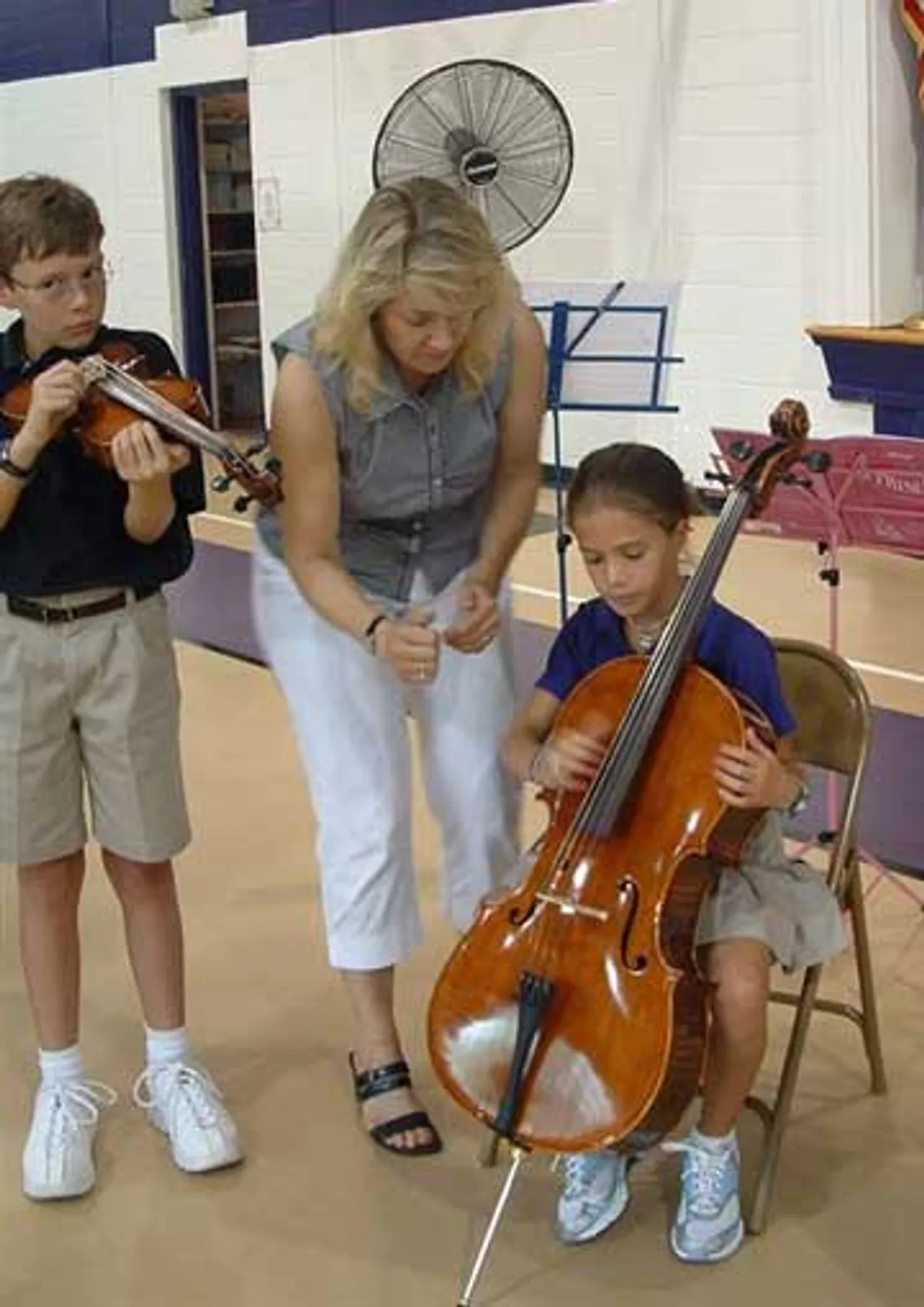
Faculty and staff at Darlington Lower School are firm believers that participation in the arts is a catalyst for increasing student motivation and achievement across the curriculum. Studies have shown that experiences with music lead not only to greater growth in the arts, but also in intellectual and personal realms of life.
This year, Darlington Lower School continues its Classics in the Classroom program, giving students the opportunity to hear music within the classroom setting, in addition to expanding its general music program to include The Darlington String Project.
“Involvement in the arts can be a powerful tool for helping educators reach a wide spectrum of learners,” said Diane Lumpkin, assistant principal. “Based on medical and psychological studies and research in learning and creativity, it has been proven that music 1) increases mental discipline and creative problem solving, 2) instills attentiveness and greater cooperation, 3) has a marked effect on abstract interpretation and conceptual development, 4) facilitates expressive activities, and 5) is a time for personal reflection.”
Eric Jensen, author of “Arts with the Brain in Mind,” writes that music enhances the “learning process by developing a student’s integrated sensory, attentional, cognitive, emotional, and motor capacities.”
Statistics prove this to be true. According to the National Association for Music Education, students of the arts continue to outperform their non-arts peers on the SAT. In 2002, those who took the SAT with coursework and experiences in music performance scored 57 points higher on the verbal portion of the test and 41 points higher on the math portion than students with no coursework or experience in the arts.
According to Lumpkin, who initiated Classics in the Classroom in 2003-04, each month a different composer will be highlighted by activities within the classroom. Teachers will be given a CD with the music of the composer of the month and will be playing this music as much as possible within the individual classroom.
“I use classical music in my classroom to promote a calm atmosphere as the children arrive and begin their morning work,” said Elaine Smith, second grade teacher. “The parents seem pleased that their children are being exposed to great classical music, and are surprised at the effect it has on a class of 7- and 8-year-olds. One parent told me that she was going to try this at home while her child did homework.”
The schedule of composers to be included in Classics in the Classroom this fall is as follows: September – Franz Schubert, the Austrian composer who created the modern German lied (song); October – Modest Moussorgsky, the Russian composer noted for his “Pictures at an Exhibition;” November – Felix Mendellssohn, German composer of Jewish heritage who helped revive some of J.S. Bach’s music and is known for his “Elijah” and “Wedding March” and December – Carlo Menotti, Italian-born composer noted as the first composer to create American opera.
After Christmas, the students will study a new group of composers: January – Antonin Dvorak, Bohemian composer who wrote “From the New World” symphony; February – Clara Schumann, German pianist, composer and teacher who was the wife of Robert Schumann; March – Engelbert Humperdinck, German composer best known for his opera “Hansel and Gretel;” April – Gioacchino Rossini, Italian composer of opera known for the “Overature” from “William Tell” and May – Woodie Guthrie, American singer, guitarist and songwriter known for “This Land is Your Land.”
The Lower School is also pleased to announce that 17 students from grades three through five have opted to be a part of The Darlington String Project. They are fifth graders Anna Forrister, Sean Healy, Hiam Johnson, Dent Law, B.J. Smith and Kathryn Wittmeier; fourth graders Lydia Clotfelter, Sydney Greene, Megan Healy, O’Keefe Johnson and Nathan Mylius; and third graders Shivani Amar, Arden Babb, Cameron Boone, Bethany Cagle, Gardland Petty and Indra Sofian.
These students meet twice a week with instructor Annie Camp to play violin, viola and cello. Camp, a graduate of Julliard who is also certified by the New York School for Strings, plays cello with the Atlanta Opera and has also performed with the Atlanta Symphony and Alabama Symphony Orchestras. She is also an adjunct professor of cello at Lee University in Cleveland, Tenn. Before moving to Georgia, Camp was a string orchestra teacher in New York City, where she designed and implemented her own original program in three elementary schools.
For more information about Classics in the Classroom or The Darlington String Project, contact Lumpkin at dlumpkin@darlingtonschool.org.
This year, Darlington Lower School continues its Classics in the Classroom program, giving students the opportunity to hear music within the classroom setting, in addition to expanding its general music program to include The Darlington String Project.
“Involvement in the arts can be a powerful tool for helping educators reach a wide spectrum of learners,” said Diane Lumpkin, assistant principal. “Based on medical and psychological studies and research in learning and creativity, it has been proven that music 1) increases mental discipline and creative problem solving, 2) instills attentiveness and greater cooperation, 3) has a marked effect on abstract interpretation and conceptual development, 4) facilitates expressive activities, and 5) is a time for personal reflection.”
Eric Jensen, author of “Arts with the Brain in Mind,” writes that music enhances the “learning process by developing a student’s integrated sensory, attentional, cognitive, emotional, and motor capacities.”
Statistics prove this to be true. According to the National Association for Music Education, students of the arts continue to outperform their non-arts peers on the SAT. In 2002, those who took the SAT with coursework and experiences in music performance scored 57 points higher on the verbal portion of the test and 41 points higher on the math portion than students with no coursework or experience in the arts.
According to Lumpkin, who initiated Classics in the Classroom in 2003-04, each month a different composer will be highlighted by activities within the classroom. Teachers will be given a CD with the music of the composer of the month and will be playing this music as much as possible within the individual classroom.
“I use classical music in my classroom to promote a calm atmosphere as the children arrive and begin their morning work,” said Elaine Smith, second grade teacher. “The parents seem pleased that their children are being exposed to great classical music, and are surprised at the effect it has on a class of 7- and 8-year-olds. One parent told me that she was going to try this at home while her child did homework.”
The schedule of composers to be included in Classics in the Classroom this fall is as follows: September – Franz Schubert, the Austrian composer who created the modern German lied (song); October – Modest Moussorgsky, the Russian composer noted for his “Pictures at an Exhibition;” November – Felix Mendellssohn, German composer of Jewish heritage who helped revive some of J.S. Bach’s music and is known for his “Elijah” and “Wedding March” and December – Carlo Menotti, Italian-born composer noted as the first composer to create American opera.
After Christmas, the students will study a new group of composers: January – Antonin Dvorak, Bohemian composer who wrote “From the New World” symphony; February – Clara Schumann, German pianist, composer and teacher who was the wife of Robert Schumann; March – Engelbert Humperdinck, German composer best known for his opera “Hansel and Gretel;” April – Gioacchino Rossini, Italian composer of opera known for the “Overature” from “William Tell” and May – Woodie Guthrie, American singer, guitarist and songwriter known for “This Land is Your Land.”
The Lower School is also pleased to announce that 17 students from grades three through five have opted to be a part of The Darlington String Project. They are fifth graders Anna Forrister, Sean Healy, Hiam Johnson, Dent Law, B.J. Smith and Kathryn Wittmeier; fourth graders Lydia Clotfelter, Sydney Greene, Megan Healy, O’Keefe Johnson and Nathan Mylius; and third graders Shivani Amar, Arden Babb, Cameron Boone, Bethany Cagle, Gardland Petty and Indra Sofian.
These students meet twice a week with instructor Annie Camp to play violin, viola and cello. Camp, a graduate of Julliard who is also certified by the New York School for Strings, plays cello with the Atlanta Opera and has also performed with the Atlanta Symphony and Alabama Symphony Orchestras. She is also an adjunct professor of cello at Lee University in Cleveland, Tenn. Before moving to Georgia, Camp was a string orchestra teacher in New York City, where she designed and implemented her own original program in three elementary schools.
For more information about Classics in the Classroom or The Darlington String Project, contact Lumpkin at dlumpkin@darlingtonschool.org.