
Last word: Joyfully serving others

By Stefan Eady - Faculty
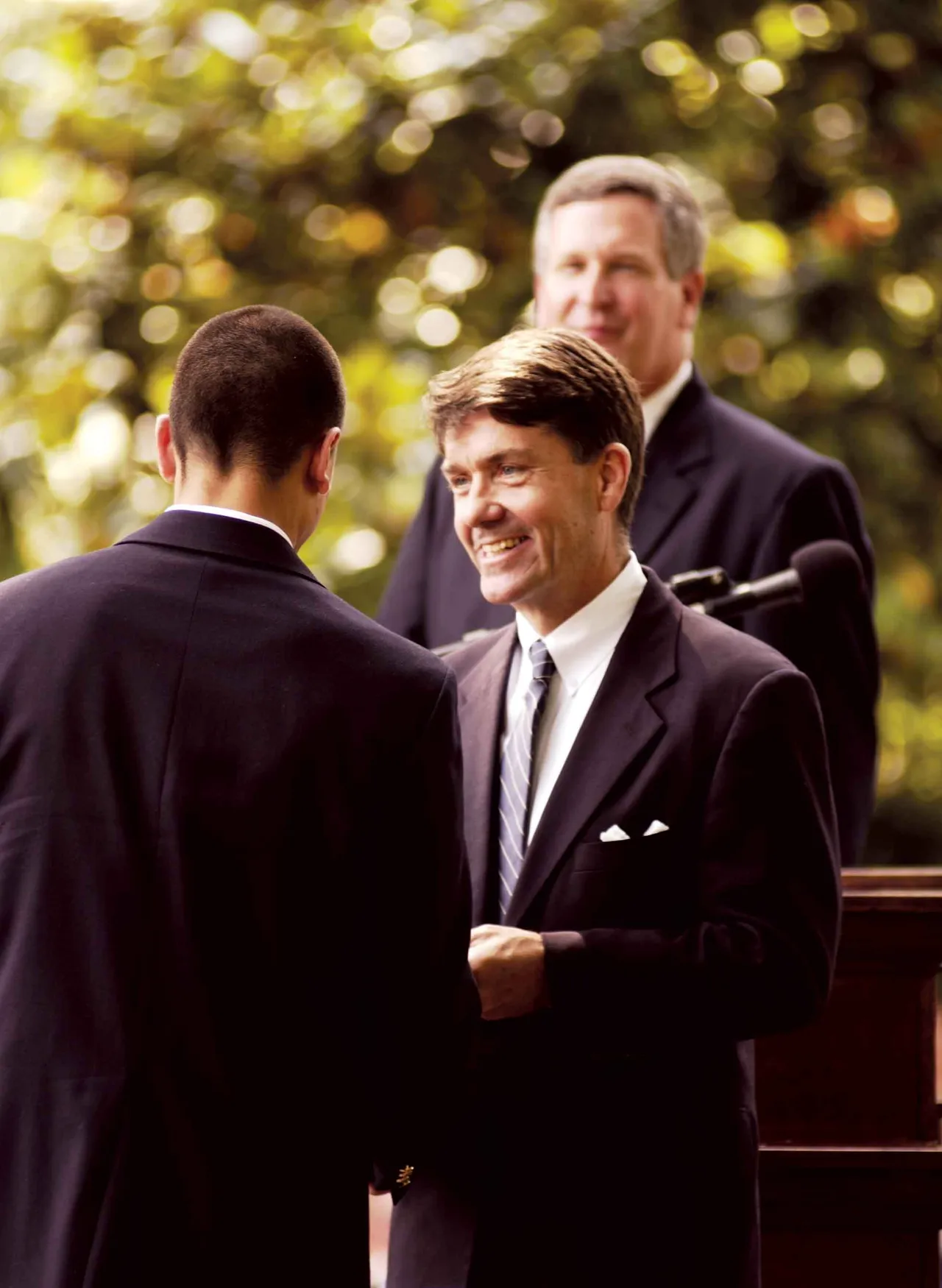
David Hicks became president in 1999. Prior to that, he was headmaster at top independent schools in Texas and New Hampshire. Hicks is a graduate of The Stony Brook School, Long Island, N.Y., and received his bachelor’s degree from Princeton University and his master’s degree from Oxford University, England, where he was a Rhodes Scholar. He is the author of two books, Norms & Nobility: A Treatise on Education (1981) and The Emporer’s Handbook: Marcus Aurelius (2002), as well as numerous articles, reviews, homilies, and essays. He and his wife, Betsy, son Peter ’03, and dog Captain live in Home-on-the-Hill.
An important part of our School’s mission and motto is “service above self.” When I addressed our seniors for the first time as graduates this spring, I concluded by saying, “I know the individuals in this class are going to do great things in the world. I hope the things you do will be for others more than for yourselves because in the end that will bring you the richest rewards.”
For those of us turning gray around the edges, this is a truism like the “happiness paradox” of the ancients. Happiness eludes those who seek it, but it comes as a by-product of seeking other things, such as the happiness of others. It takes some living, I suppose, to know how true these truisms are. The experience of selfishness – our own and other’s – proves these truisms every day.
There are many ways we at Darlington try to impress these lessons upon our students and save them the frustration and wasted time of having to learn these lessons through the bitter disappointments of selfishness and self-absorption. In addition to School-wide charitable projects like Darlington Christmas, there are ongoing community service projects by each House and activities, like campus recycling, by the ASA service group. Of course, the work of the 72 prefects in the six Houses is a constant witness of “service above self.”
It is also, I think, appropriate to ask: how does the School as a whole model good citizenship in Rome and try to share its privileged and blessed position with the community? This is a tricky question. On the one hand, we don’t want to become distracted in our educational mission. We exist to serve the students and families who choose to join us. But on the other hand, part of that service is surely to be the kind of school we want our students and graduates to be: a group of concerned, active, other-directed citizens doing what we can to build a healthy and just community.
When it comes to the bumper sticker we’ve all seen: THINK GLOBALLY; ACT LOCALLY, academic institutions are usually better at the thinking part than the acting. That is probably true for most citizens as well. The question for us is: how can Darlington best serve Rome as well as our nation?
Recently, we have interpreted our citizen’s duty to mean taking an active role in the revitalization of the deteriorating neighborhood around us in South Rome. Over the past six months, I have had the pleasure of serving as board chair for the newly formed South Rome Redevelopment Corporation. This board, which represents the rich diversity of our immediate neighborhood, has hired a dynamic, young director, successfully opposed inappropriate rezoning requests, and is about to hire a planning consultant to develop a bold and visionary master plan for the redevelopment of South Rome. The board successfully garnered support for a SPLOST vote on June 17 that includes a beautiful new County health facility on the site of the old Anchor Duck Mill, a reclamation project that could be pivotal in the revitalization of South Rome.
Change of this sort takes time, and it must start, of course, in people’s minds. But we have started to form solid friendships with our neighbors, one of the most rewarding by-products of working together for the common good.
It is my hope that Darlington will continue to be actively engaged in this process and that eventually our students will have a role to play in the master plan. One of the finest lessons they could learn while at Darlington is not only the joy of service, but the example of seeing a neighborhood as diverse as America, with all of America’s ills and challenges, reverse its course and pull together to achieve something beautiful and good for all people. This is a lesson of hope, and our graduates will take it with them wherever they go, along with the knowledge of how to change things for the better.