
NewsUpper SchoolStudent LifeFaculty/StaffAlumniAdvancementServiceAcademicsResidential Life
J.J. Darlington Celebration features remarks from '62 alumnus
Feb 10, 2005 8:00 AM
By Tannika King - Faculty
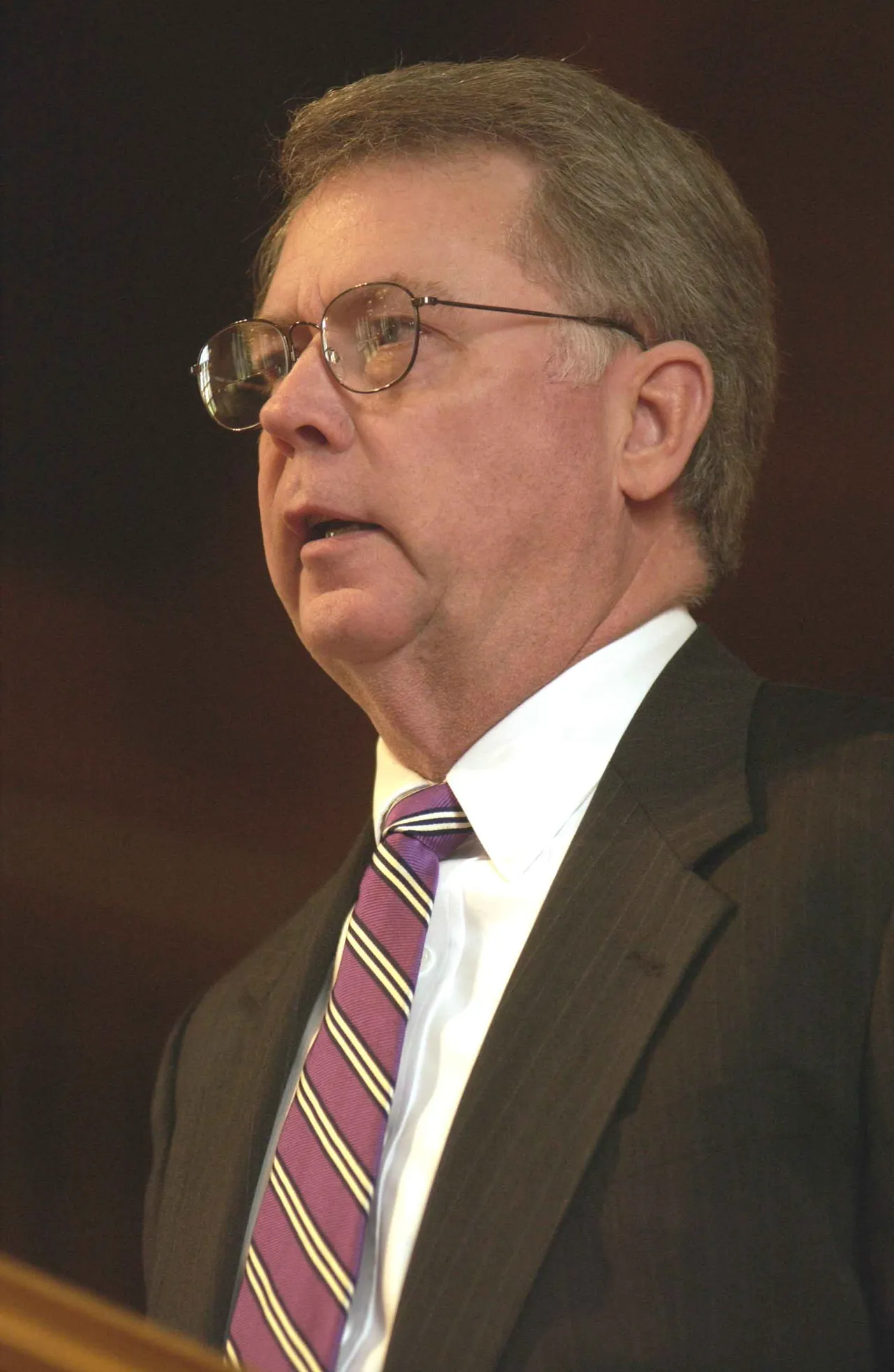
Read the full text of the address given by Gordon Lee Hight II (’62) at the J.J. Darlington Birthday Celebration Thursday, Feb. 10, 2005:
President Hendrix, faculty and administrators who devote your days to the betterment of young people, and students in the midst of the fits and starts of your personal development, I am honored to be here with you. Any invitation to serve at Darlington is to be cherished, and I feel most blessed today.
In the brilliant words of Bill Cosby, like you “I started off as a child.” For that reason we’re on common ground.
Today we celebrate the birthday of Mr. J.J. Darlington, for whom this school was named. His name was chosen because he was remembered as a great teacher. This school has a rich and long tradition of men and women whose lives of service cast long shadows on this and earlier campuses. I’m sure you have been told that the faculty of today are a collection of great teachers. Whoever writes your tuition checks must think so. Aside from time away for higher education and military service, it has been my blessing to have been around here for the second half of Darlington’s first century, and I know that, subject to the occasional exception, you are blessed with a faculty with immense capacity for teaching.
Does it matter? Hold that thought; we will get back to it.
Until my dear friend, Jim Hendrix arrived, I had managed to get into trouble with every president that Darlington has ever had. Once, while serving my fellow trustees as their chairman, I stood right here and did what had been a dream during my seven years as a student – I said a very few words and then let the kids out early. Regrettably, you may conclude that I satisfied that urge at that time. Dr. Hendrix suggested that I might speak about great teaching. Sorry Jim, but I came today moved to speak of great learning. That was the objective of Mr. Darlington’s teaching career.
First, a quick story. A mother went into her son’s room one morning to wake him up for school. He said, “I’m not going.” “And why not?” she asked. He responded, “Two reasons: they don’t like me and I don’t like them.” She answered, “Well, I’ll give you two reasons why you are going. You are 48 years old, and you are the headmaster.”
Now I’m in trouble with the headmaster. Sorry, David, and it is now for me to fear your retribution. Yet, I did think the story hinted of a peril, which our graduates will reencounter along with their college freedoms. That is choices, which could be wasteful of opportunities.
In 1959, while some grownup was droning on up here, I sat over there in the small section of pews on the side – third row, second seat over – and made myself a solemn promise to always remember what it is like to be 15 years old. I didn’t like what being a grownup looked like. I have faithfully and intentionally kept that promise to the best of my abilities. I have dodged, skirted, avoided and evaded becoming a grownup with determination. There are those who will tell you that I have had some success in this. But it has come at a price. There can be an arrogance in ignorance.
In my junior year at Darlington, a man named John Kenyon tried to teach me American Literature. I did not come to learn. In my college years, American Lit was taught by a professor known disaffectionately, and with good reason as “Boothead” Moore. I avoided him, and now, just about all that I know about the literature of my native land is that “two roads diverged in a yellow wood” and “Good fences make good neighbors.” My lament is that I will never get to pass this way again.
In my senior year here, my English instructor was one of the grandest teachers in the history of Darlington – E.V. “Doc” Regester. Despite my resistance to most things held out by grownups as being “beneficial for me” and without my awareness of it, Doc kindled within my inert and childish intellect, an appreciation for the loveliness of gifted expression.
Doc led us to meet writers possessed of the greatest capacity for conception and expression in the history of the English language. As he read to us then, I say to you now, from a memory spanning those 43 years, “There is a tide in the affairs of men, which taken at the flood leads on to fortune, omitted, all the voyage of their lives is bound in shallows and in miseries. Upon a full sea we are now afloat and we must take the current when it serves or lose our ventures.” Young leaders of the future world, I say to you that today your surf is up.
Other things stick in my memory. There was once a day in college English class, when the most beloved of all our faculty fondly said in his own prodding style, as he eventually did to each of us, “Moss, don’t expect to pass. You must fail – justice demands it.” There was my big brother in the fraternity who went on to Oxford on a Rhodes scholarship and later as a secondary school teacher was the real-life model for the role played by Robin Williams in the movie about passion for learning entitled “Dead Poets’ Society.”
There was my lifelong friend and Darlington classmate, perhaps the most brilliant and possibly the most unguided mind in our class, who used to conclude arguments with the emphatic assertion that “it is a known fact.” Stop and think about that for a minute. Within the realm of that which is knowable, how much do we know? How much do we know that we don’t know? And what are the possibilities for a far more vast universe of things that we don’t even know that we don’t know? Awareness of this can lead to a humility, which offers a great platform for personal growth.
It occurred to me that you might like to see the diploma of the first student to enter Darlington School. He arrived in the fall of 1905 and received the diploma framed on the left on May 27, 1956 – 51 years later. He was my grandfather. It took our family four generations of crossbreeding to produce our first academic achievers at Darlington. The rest of the truth is that in the early days, they had no diplomas. Later, my grandfather, then a trustee, jokingly complained to Dr. Wilcox until he finally was given one. The one on the right is mine, which I received just six years after my grandfather got his.
For your safety, we closed the gate by the pedestrian underpass because it emptied into a blind curve. There is a plaque inset into that old gate which reads, “Enter by this gate and grow in manhood, wisdom, and honor.” Not so different from our motto today. I sat where you are sitting now many times, listening to grownup speakers whose only apparent qualification was that they had waited long enough for it to be their turn. They often spoke of wisdom. I wondered what it was, would I ever get any of it, and if so, how. I’m still wondering, but I have been among some who had it in large measures.
Cardinal John Henry Newman wrote on the scope and nature of university education that “knowledge, then, is the indispensable condition of expansion of mind, and the instrument of attaining to it.” I take that to mean that if the goal is wisdom, intellectual growth and development of powers of intelligent thought – which would enrich any of our lives – then the process of achieving it begins with the assimilation of knowledge. Wisdom comes to those who make a choice to develop their minds. Wise people have good judgment and if you have that you will be sought out and asked to lead.
Incidentally, my favorite from Cardinal Newman is that “it is almost a definition of a gentleman to say he is one who never inflicts pain ... he is tender towards the bashful, gentle towards the distant, and merciful toward the absurd.” Hopefully, no one in your classrooms strains the teachers to practice that last quality.
Why do we study history? It gives us the advantage of the collective experience of all of our human predecessors. We study literature because it develops our capacity to conceive thoughts and feelings and to express them. Mathematics refines our powers of logic and reason and our ability to solve problems. Science is the pathway to understanding the physical and biological world in which we will each live out our precious only life. Language expands our personal horizons as well as our ability to communicate.
The greatest educator in the world could stand outside and deliver to a tree the most profound lecture ever given. Without a student to hear the lecture, nothing good would come of it. The virtue of education lies not in the teaching, but in the learning. And for something good to come of it, my fellow Darlingtonians, that lies entirely with you. Stretching and building the muscle of your intellect is often uncomfortable and sometimes dreary, but it is your only route to the rich and full life that can be yours. It is your choice to be an intellectual potato or, in the words of the Phantom of the Opera you can let your “spirit soar.” You owe it to yourselves to take the current when it serves.
A few parting thoughts: (1) About being really prepared for essay questions –you don’t really grasp a concept until you can explain it to someone else; (2) Real fulfillment lies not in your own achievements, but in discovering the joy of doing for others; (3) You are probably not the first one to have the ideas, which you consider cleverly brilliant. I promised Dr. Hendrix that I would not tell you the story about my father derailing the street car that once ran from town to here; (4) Do not worry if you will have opportunity. Instead, develop the vision to recognize it and have yourself prepared to take advantage of it when it inevitably does come.
Those who have gone before you are excited for you, we are confident in you, we respect you and wish for you the very best. Nothing would make Mr. Darlington’s birthday happier for him than to see you choose to become great learners.
President Hendrix, faculty and administrators who devote your days to the betterment of young people, and students in the midst of the fits and starts of your personal development, I am honored to be here with you. Any invitation to serve at Darlington is to be cherished, and I feel most blessed today.
In the brilliant words of Bill Cosby, like you “I started off as a child.” For that reason we’re on common ground.
Today we celebrate the birthday of Mr. J.J. Darlington, for whom this school was named. His name was chosen because he was remembered as a great teacher. This school has a rich and long tradition of men and women whose lives of service cast long shadows on this and earlier campuses. I’m sure you have been told that the faculty of today are a collection of great teachers. Whoever writes your tuition checks must think so. Aside from time away for higher education and military service, it has been my blessing to have been around here for the second half of Darlington’s first century, and I know that, subject to the occasional exception, you are blessed with a faculty with immense capacity for teaching.
Does it matter? Hold that thought; we will get back to it.
Until my dear friend, Jim Hendrix arrived, I had managed to get into trouble with every president that Darlington has ever had. Once, while serving my fellow trustees as their chairman, I stood right here and did what had been a dream during my seven years as a student – I said a very few words and then let the kids out early. Regrettably, you may conclude that I satisfied that urge at that time. Dr. Hendrix suggested that I might speak about great teaching. Sorry Jim, but I came today moved to speak of great learning. That was the objective of Mr. Darlington’s teaching career.
First, a quick story. A mother went into her son’s room one morning to wake him up for school. He said, “I’m not going.” “And why not?” she asked. He responded, “Two reasons: they don’t like me and I don’t like them.” She answered, “Well, I’ll give you two reasons why you are going. You are 48 years old, and you are the headmaster.”
Now I’m in trouble with the headmaster. Sorry, David, and it is now for me to fear your retribution. Yet, I did think the story hinted of a peril, which our graduates will reencounter along with their college freedoms. That is choices, which could be wasteful of opportunities.
In 1959, while some grownup was droning on up here, I sat over there in the small section of pews on the side – third row, second seat over – and made myself a solemn promise to always remember what it is like to be 15 years old. I didn’t like what being a grownup looked like. I have faithfully and intentionally kept that promise to the best of my abilities. I have dodged, skirted, avoided and evaded becoming a grownup with determination. There are those who will tell you that I have had some success in this. But it has come at a price. There can be an arrogance in ignorance.
In my junior year at Darlington, a man named John Kenyon tried to teach me American Literature. I did not come to learn. In my college years, American Lit was taught by a professor known disaffectionately, and with good reason as “Boothead” Moore. I avoided him, and now, just about all that I know about the literature of my native land is that “two roads diverged in a yellow wood” and “Good fences make good neighbors.” My lament is that I will never get to pass this way again.
In my senior year here, my English instructor was one of the grandest teachers in the history of Darlington – E.V. “Doc” Regester. Despite my resistance to most things held out by grownups as being “beneficial for me” and without my awareness of it, Doc kindled within my inert and childish intellect, an appreciation for the loveliness of gifted expression.
Doc led us to meet writers possessed of the greatest capacity for conception and expression in the history of the English language. As he read to us then, I say to you now, from a memory spanning those 43 years, “There is a tide in the affairs of men, which taken at the flood leads on to fortune, omitted, all the voyage of their lives is bound in shallows and in miseries. Upon a full sea we are now afloat and we must take the current when it serves or lose our ventures.” Young leaders of the future world, I say to you that today your surf is up.
Other things stick in my memory. There was once a day in college English class, when the most beloved of all our faculty fondly said in his own prodding style, as he eventually did to each of us, “Moss, don’t expect to pass. You must fail – justice demands it.” There was my big brother in the fraternity who went on to Oxford on a Rhodes scholarship and later as a secondary school teacher was the real-life model for the role played by Robin Williams in the movie about passion for learning entitled “Dead Poets’ Society.”
There was my lifelong friend and Darlington classmate, perhaps the most brilliant and possibly the most unguided mind in our class, who used to conclude arguments with the emphatic assertion that “it is a known fact.” Stop and think about that for a minute. Within the realm of that which is knowable, how much do we know? How much do we know that we don’t know? And what are the possibilities for a far more vast universe of things that we don’t even know that we don’t know? Awareness of this can lead to a humility, which offers a great platform for personal growth.
It occurred to me that you might like to see the diploma of the first student to enter Darlington School. He arrived in the fall of 1905 and received the diploma framed on the left on May 27, 1956 – 51 years later. He was my grandfather. It took our family four generations of crossbreeding to produce our first academic achievers at Darlington. The rest of the truth is that in the early days, they had no diplomas. Later, my grandfather, then a trustee, jokingly complained to Dr. Wilcox until he finally was given one. The one on the right is mine, which I received just six years after my grandfather got his.
For your safety, we closed the gate by the pedestrian underpass because it emptied into a blind curve. There is a plaque inset into that old gate which reads, “Enter by this gate and grow in manhood, wisdom, and honor.” Not so different from our motto today. I sat where you are sitting now many times, listening to grownup speakers whose only apparent qualification was that they had waited long enough for it to be their turn. They often spoke of wisdom. I wondered what it was, would I ever get any of it, and if so, how. I’m still wondering, but I have been among some who had it in large measures.
Cardinal John Henry Newman wrote on the scope and nature of university education that “knowledge, then, is the indispensable condition of expansion of mind, and the instrument of attaining to it.” I take that to mean that if the goal is wisdom, intellectual growth and development of powers of intelligent thought – which would enrich any of our lives – then the process of achieving it begins with the assimilation of knowledge. Wisdom comes to those who make a choice to develop their minds. Wise people have good judgment and if you have that you will be sought out and asked to lead.
Incidentally, my favorite from Cardinal Newman is that “it is almost a definition of a gentleman to say he is one who never inflicts pain ... he is tender towards the bashful, gentle towards the distant, and merciful toward the absurd.” Hopefully, no one in your classrooms strains the teachers to practice that last quality.
Why do we study history? It gives us the advantage of the collective experience of all of our human predecessors. We study literature because it develops our capacity to conceive thoughts and feelings and to express them. Mathematics refines our powers of logic and reason and our ability to solve problems. Science is the pathway to understanding the physical and biological world in which we will each live out our precious only life. Language expands our personal horizons as well as our ability to communicate.
The greatest educator in the world could stand outside and deliver to a tree the most profound lecture ever given. Without a student to hear the lecture, nothing good would come of it. The virtue of education lies not in the teaching, but in the learning. And for something good to come of it, my fellow Darlingtonians, that lies entirely with you. Stretching and building the muscle of your intellect is often uncomfortable and sometimes dreary, but it is your only route to the rich and full life that can be yours. It is your choice to be an intellectual potato or, in the words of the Phantom of the Opera you can let your “spirit soar.” You owe it to yourselves to take the current when it serves.
A few parting thoughts: (1) About being really prepared for essay questions –you don’t really grasp a concept until you can explain it to someone else; (2) Real fulfillment lies not in your own achievements, but in discovering the joy of doing for others; (3) You are probably not the first one to have the ideas, which you consider cleverly brilliant. I promised Dr. Hendrix that I would not tell you the story about my father derailing the street car that once ran from town to here; (4) Do not worry if you will have opportunity. Instead, develop the vision to recognize it and have yourself prepared to take advantage of it when it inevitably does come.
Those who have gone before you are excited for you, we are confident in you, we respect you and wish for you the very best. Nothing would make Mr. Darlington’s birthday happier for him than to see you choose to become great learners.