
Darlington's Backyard

By Stefan Eady - Faculty
The first time I ever set foot on this campus, I knew it was a special place. It was on a warm, clear, spring day with all the clichés of natural beauty: the birds were chirping, the swans were swimming, the bees were buzzing, and I, with resume in hand and prejudice in my heart (for don’t we all judge books by their covers?), strolled about the campus with the subconscious question that must face all prospective faculty, parents, and students: Is this a place I can call home?
For many of us on the first visit to our seductive Juliet of a campus, the answer is like Romeo’s. “Did my heart love till now? Forswear it, sight!/ For I never saw true beauty till this night.” This love-at-first-sight phenomenon occurs over and over again, not only to those seeking Darlington out, but also to those who happen upon Darlington by accident or invitation. When Buzz Bissinger, the Friday Night Lights author and himself a graduate of a fancy campus at Phillips Andover, mentioned in his April address to the School that Darlington’s campus is “the most beautiful” he had ever seen, complete with “a lake with real swans!”, he was restating what we all know to be true. Darlington’s campus is indeed a special place. But what exactly makes it so special?
Of course, it’s those highly visible aspects of the campus that get most of the credit. The houses that we work in and live in get top billing: Morris Chapel, Home-on-the-Hill, the red brick Gothic-revival halls of Wilcox, South, and Sydenham, and more recently the new A. J. Huffman Center, which extends the architectural magnificence across Cave Spring Road to the athletic venues. In a starring role opposite these houses are the flora of the campus. Stately oaks and pines, maples and birches, topped off with rows of azaleas and smatterings of dogwoods, give the campus a pristine, Southern garden quality that makes Darlington, like Juliet, almost a “Beauty too rich for use, for earth too dear.”
To me, this main part of campus where most of us spend our time is Darlington’s front yard. It’s neat, it’s pretty, and it’s well manicured. But lots of schools have beautiful front yards. They have their trimmed hedges and their fancy flowers and their shamelessly big buildings. But no campus that I’ve seen has the third element in the boarding school as home equation, the part you don’t see and the part that you take for granted: a backyard. For, while Darlington is bounded on the north by a bridge, on the south by Darlington Drive, and on the east by a creek and railroad, in the back, on the western side, rests – in my mind – the crown upon the campus – its mini-mountain of woods and trails.
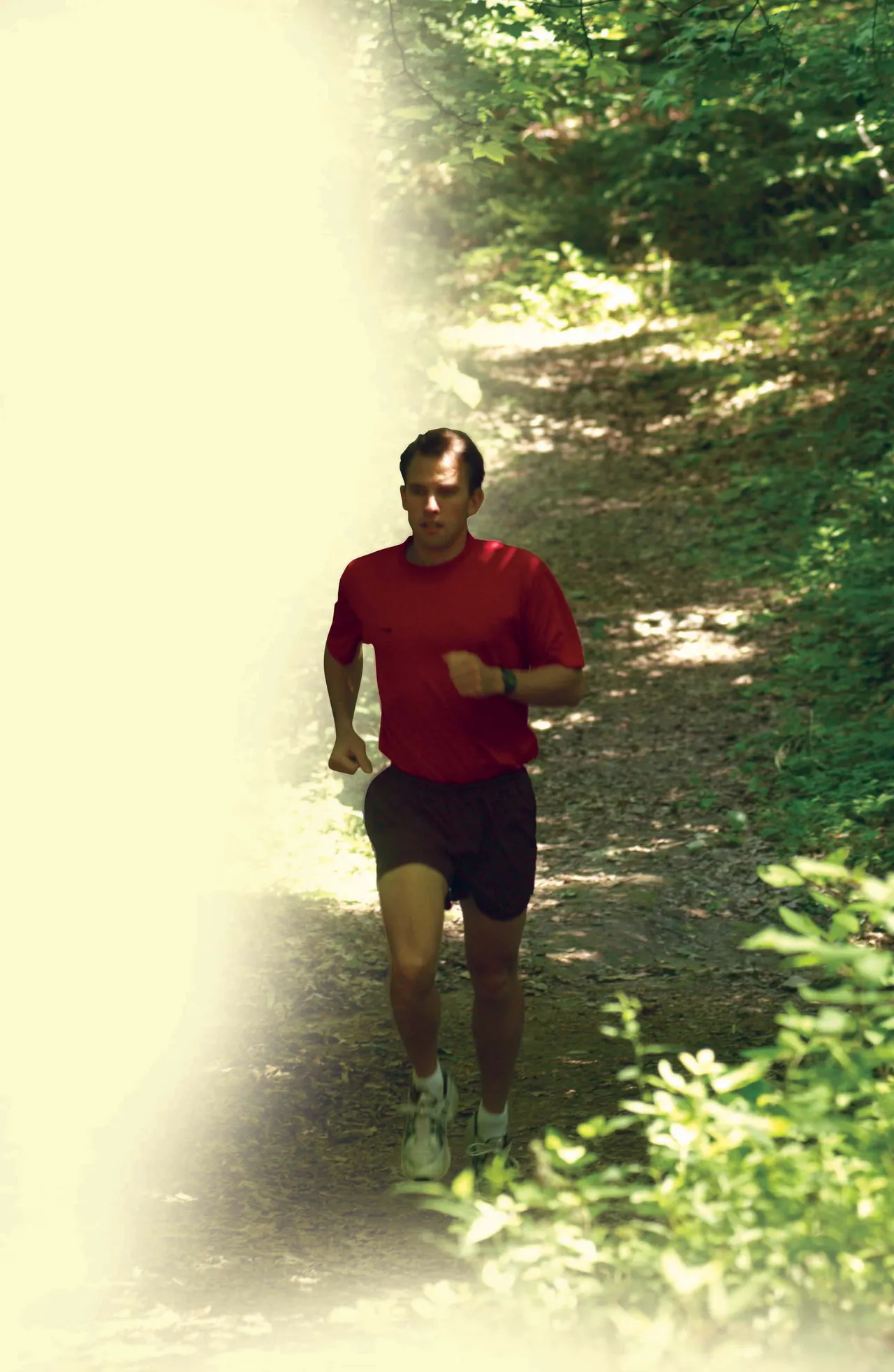
These 300 acres of wooded mountainside provide a buffer from the outside community, a buffer from Black’s Bluff Road and the Coosa River. Our acres of hillside are a wall that allows us to feel so settled, so cozy as we laze about Silver Lake or as we saunter up to dinner from the tunnel after an afternoon of sports. In the evening, our wooded mountainside is shelter from the sun, and in the fall our woods are an autumnal headdress where cross country teams run and race. Our campus backyard is the home to over three miles of trail that provide a tranquil escape from the communal, public lives that we lead here. Our trails are a haven for hustling hounds, a destination for family walks, a challenge for hikers and bikers, and a retreat for jogging administrators. Each fall, visiting middle school cross country teams come to try to conquer one particular trail, infamously named “Billy Goat” for its extreme 120-meter incline, just because, like Mount Everest, it’s there.
Today our trails give memory to extraordinary school names like Porter and McCain, but they are also a place of dimmer memories – of old logging roads, of a forgotten clearing where the decrepit brick remnants of houses and fireplaces are now hidden by vast patches of kudzu, of a stone house mysteriously placed in the valley of a trail, of a stone terrace randomly placed on a hillside, a sort of outdoor room without a view. There is an ancient tree house that overlooks the Neville soccer fields and what are now lacrosse fields, and there are secret caves, some sealed up, as well as a triangular lake that only old-timers know of.
Darlington’s campus is a special place, and its back yard is an important part of it. It is a secret place. It is a place of escape. It is the unacknowledged part of our campus that gives the School its privacy and that gives its people a place to breathe. Its rustic landscape is a natural complement to the pruned picture most of us have of the campus, and for me it makes our School a home.