NewsUpper SchoolStudent LifeFaculty/StaffAlumniPre-K to 8AdvancementService
Climber transforms the image of blindness, sets sights higher
Sep 29, 2003 8:00 AM
By Stefan Eady - Faculty
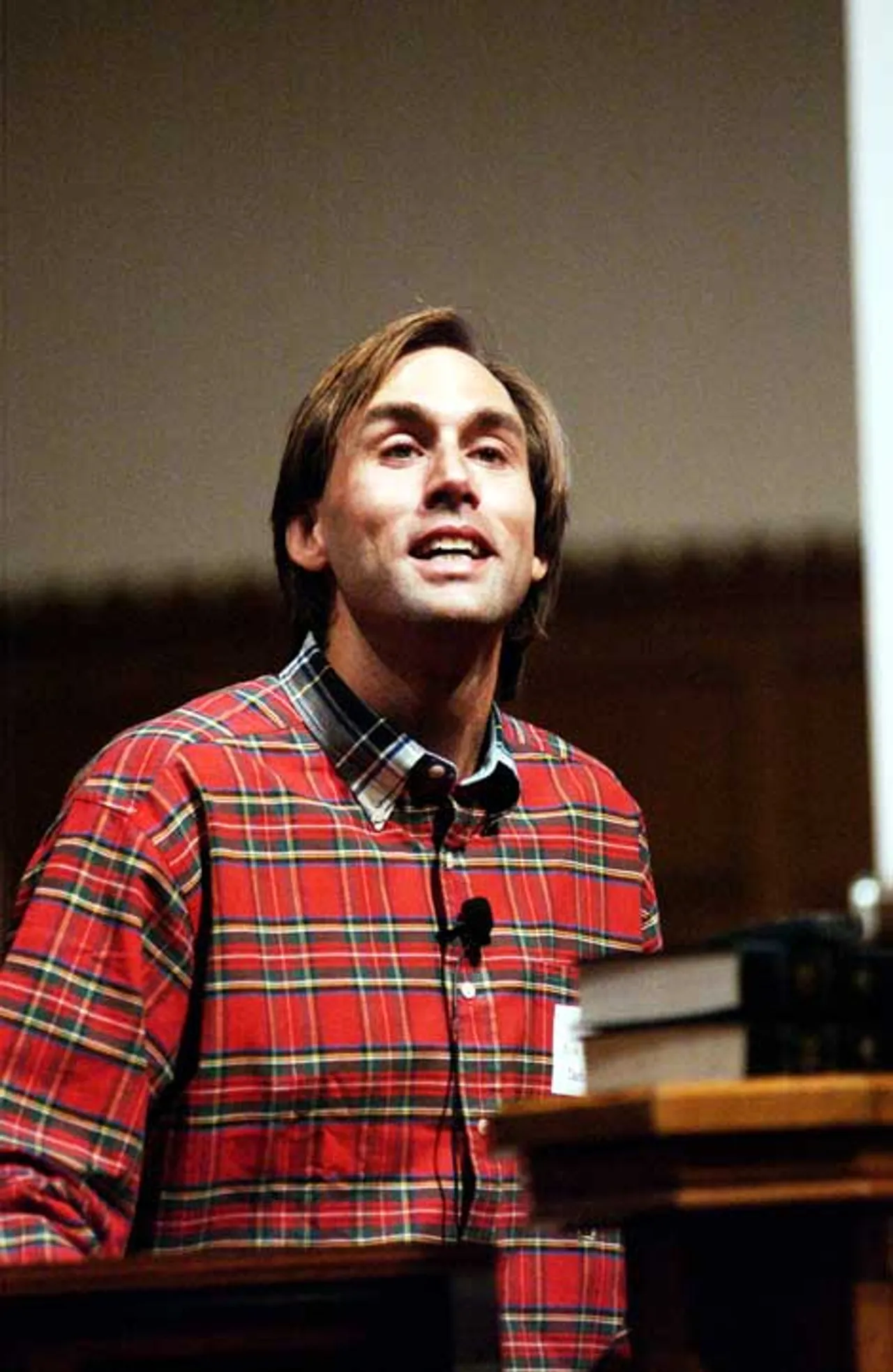
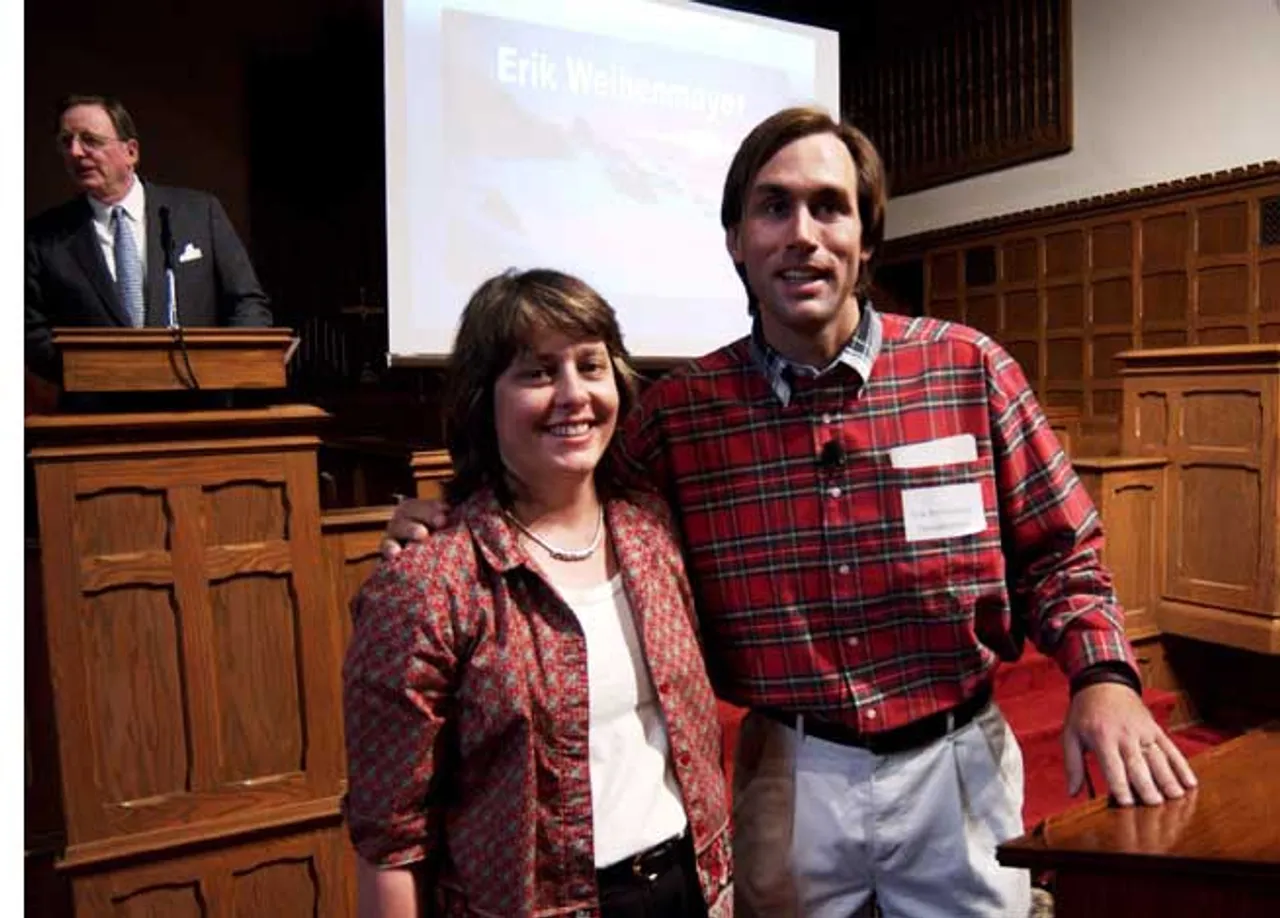
Erik Weihenmayer, the first blind climber to summit the traditional Seven Summits, spoke to the Rome community and the Darlington School community during two presentations in September. “Become a pioneer of your own lives; cross the blurry lines of what the world sees as possible and what you think might be possible,” was one of the many life’s lessons that Weihenmayer shared based on the obstacles he has faced and the amazing achievements he has reached. “If someone’s expectations of you become barriers, it’s OK to throw those expectations away,” he said.
Darlington Board of Trustee member George Johnson, who made this inspiring speaker’s visit possible, introduced Weinhenmayer to an audience of 400 people from the Darlington and Rome community on Wednesday evening, Sept. 24, in the Morris Chapel and again to students in fourth through twelfth grade, parents, and faculty the next morning in the Van Es Arena. Weihenmayer’s book, Touch the Top of the World: A Blind Man’s Journey to Climb Farther than the Eye Can See was mailed to every Middle and Upper School student prior to the start of school.
He began his quest to conquer the seven summits in 1995 by scaling Mount McKinley in Alaska. Two years later he scaled Mount Kilimanjaro in Africa. Weihenmayer then scaled the top peaks in South America and Antarctica. Next he topped the highest peak in Europe, Mount Elbrus. On May 25, 2001, Weihenmayer, now 34, became the first blind climber in history to reach the summit of Mt. Everest. He ascended to the top of Mt. Kosciuszko, the highest peak in Australia, on Sept. 5, 2002, amid fog and strong winds. “I had a wonderful team,” he said. “All in all, we got 19 of us to the summit, which actually I think is still a standing record: the most people from one team to get to the top in a single day. So we had more than just one record broken that day.”
Erik Weihenmayer was born with retinoscheses, a degenerative eye disorder that progressively unraveled his retinas. He lost his sight by age 13 and his mother in a tragic car accident the next year, and his life is a testament to his belief that “you should not compensate for your differences but instead see your differences as strengths.”
“Everything I needed was inside me or in front of my eyes, if I just reached for it,” he said. “Reach out for the immense possibilities.”
Weihenmayer is a world-class athlete: acrobatic skydiver, long distance biker and marathon runner, skier, mountaineer, ice climber, and rock climber. He was the first blind man to summit McKinley, scale the infamous 3,300-foot rock wall of El Capitan and then Argentina’s Aconcagua. He was married to his longtime sweetheart at 13,000 feet on Kilimanjaro and now lives in Colorado with his wife and daughter, where he teaches fifth grade.
As one of four members of Team No Boundaries, he competed beginning Sept. 5, in Subaru Primal Quest, billed as the toughest, most competitive, and richest adventure race in the world. The 450-mile race in the Lake Tahoe area of the Sierra Nevadas involved mountain biking, white water paddling, rappelling, trekking, and even caving, at elevations up to 11,000 feet. Eighty teams participated; Weihenmayer’s team was one of the 42 that completed the race.
Reflections by faculty members on Weihenmayer’s talk:
“It was very inspirational to listen to him and realize that we should reach for the stars no matter what other people say… That was like when I ran the Boston Marathon five years ago even though my friends laughed and said I couldn’t do it. It felt awesome to see how amazed they were that I did it… My mission now is to be an excellent teacher, coach, and role model to the kids I work with. I am also using his example towards the swim team by telling them about leadership, teamwork, and that anything is possible if you put your mind to it.”—Rob Meaney, Upper School instructor, head swimming coach, and assistant varsity girls lacrosse coach
“His message made me give thanks for my sight… On my afternoon walk with my dog, I was much more aware of common things such as trees, pine cones, light reflecting from the lake… Erik has a powerful message that deeply touched me.”—Charlotte Saxon, Upper School instructor, swimming assistant coach, JV girls tennis head coach
“I blindfolded my students for most of my class periods after Erik’s talk and had them navigate around parts of campus. Then they wrote about that experience and I asked them whether they thought Erik would trade his accomplishments if he could have his sight instead (most thought that he wouldn’t trade), whether they thought Erik would have climbed the seven peaks if he had not been blind (most thought he wouldn’t have, but everyone agreed that he would have different accomplishments of equal greatness), whether they would give up their sight if they could live out their fantasy (half thought yes they would have thought no), and whether they thought it was better to have sight and lose it or never have it all (they couldn’t come to any final resolution to that question). Students came to realize in the discussion that it is Erik’s character that separates him from others, not his blindness.”—Mac Jackson, Upper School instructor, boys lacrosse assistant coach, and Middle School football assistant coach
“As a person that has physical limitations (I am an insulin-dependent diabetic), Erik’s message was quite meaningful to me. I often think about myself in terms of my limitations, and he made me realize that most of those limitations are not real. I just need to work harder to think of ways to find ways to compensate.”—Bob McGraw, Upper School instructor and community service ASA adviser
“His motivational talk was of a different sort from most. He did not cheerlead or scream; he challenged in a calm voice. I did hear one kid saw he didn’t ‘seem blind’… I think that somewhere in his book he says (paraphrasing rather than quoting here), blind people are dogs just like anybody else—no nobler or more wise than the sighted; just as out for a thrill or a pickup as anyone; exactly, NO DIFFERENT.”—Skip Saunders, Upper School instructor, college adviser, IMPACT Club adviser; varsity wrestling assistant coach
“I have never heard a person speak that I respected more. He showed us what a true hero can do. He took adversity and turned it into inspiration for the rest of us.”—Pat Waddell, Upper School instructor, Chess Club adviser, swimming/diving assistant coach
“Through Erik’s sharing with our Darlington community I grasped the notion that how we respond to life makes all the difference. We can be and remain blind to the vast possibilities for good to be found in and through all of life’s circumstances or we can create and explore with courage and confidence opportunities for making good things happen even in the darkest and most unlikely situations. To a great extent it’s a matter of believing we can make a positive difference and acting in response to a greater vision of what we set out to experience and accomplish in life.”—Gordon Neville, associate headmaster and dean of students; Upper School instructor, Discipline Committee adviser
Reflections by senior Lydie White
reprinted by permission from The Darlingtonian student newspaper, October 2003 issue
Upon initially hearing that we would be having Eric Weihenmayer as a guest speaker, I paid little attention. I was ignorant of his story and his accomplishments. Chapel speeches are generally intriguing but not life-changing messages. However as the weeks approaching his visit decreased, I learned more. A blind guy climbing Mount Everest—I had to do a double take on that idea. I could not even imagine hiking Mount Everest with two perfectly adequate eyes. Only 20 percent of those who attempt to summit Mt. Everest succeed. After learning of all the feats he had completed, I began to anticipate his message to me. On Thursday, Sept. 25, Weihenmayer talked to the student body at Darlington.
I did not know what to expect. What would he say to me about his incredible journeys? I felt inferior; what had I accomplished despite colossal obstacles before me? To overcome all that he had was amazing and even mind-boggling when I contemplated his life. I expected his speech to be glorious but definitely over my head, unable to relate with me. His accomplishments were incredible, but would it be too hard to really get something from his message?
After hearing it, I am so impressed and pleased that Darlington hosted such an incredible man. His message was encouraging, to say the least. He filled the auditorium with intrigue and his quest to succeed. I found him down-to-earth and a true optimist, no matter how dark the situation. He did not come to Darlington to assert his glory or his achievements; Weihenmayer came to encourage and remind all of us to do what it is that we passionately desire no matter what boundaries separate us from obtaining the success. As he accounted his own journey, he gave me incentive to use what I have to be successful in whatever inspires me. Weihenmayer’s simple message is one that I, myself, often overlook, and it is so refreshing to be reminded.
Darlington Board of Trustee member George Johnson, who made this inspiring speaker’s visit possible, introduced Weinhenmayer to an audience of 400 people from the Darlington and Rome community on Wednesday evening, Sept. 24, in the Morris Chapel and again to students in fourth through twelfth grade, parents, and faculty the next morning in the Van Es Arena. Weihenmayer’s book, Touch the Top of the World: A Blind Man’s Journey to Climb Farther than the Eye Can See was mailed to every Middle and Upper School student prior to the start of school.
He began his quest to conquer the seven summits in 1995 by scaling Mount McKinley in Alaska. Two years later he scaled Mount Kilimanjaro in Africa. Weihenmayer then scaled the top peaks in South America and Antarctica. Next he topped the highest peak in Europe, Mount Elbrus. On May 25, 2001, Weihenmayer, now 34, became the first blind climber in history to reach the summit of Mt. Everest. He ascended to the top of Mt. Kosciuszko, the highest peak in Australia, on Sept. 5, 2002, amid fog and strong winds. “I had a wonderful team,” he said. “All in all, we got 19 of us to the summit, which actually I think is still a standing record: the most people from one team to get to the top in a single day. So we had more than just one record broken that day.”
Erik Weihenmayer was born with retinoscheses, a degenerative eye disorder that progressively unraveled his retinas. He lost his sight by age 13 and his mother in a tragic car accident the next year, and his life is a testament to his belief that “you should not compensate for your differences but instead see your differences as strengths.”
“Everything I needed was inside me or in front of my eyes, if I just reached for it,” he said. “Reach out for the immense possibilities.”
Weihenmayer is a world-class athlete: acrobatic skydiver, long distance biker and marathon runner, skier, mountaineer, ice climber, and rock climber. He was the first blind man to summit McKinley, scale the infamous 3,300-foot rock wall of El Capitan and then Argentina’s Aconcagua. He was married to his longtime sweetheart at 13,000 feet on Kilimanjaro and now lives in Colorado with his wife and daughter, where he teaches fifth grade.
As one of four members of Team No Boundaries, he competed beginning Sept. 5, in Subaru Primal Quest, billed as the toughest, most competitive, and richest adventure race in the world. The 450-mile race in the Lake Tahoe area of the Sierra Nevadas involved mountain biking, white water paddling, rappelling, trekking, and even caving, at elevations up to 11,000 feet. Eighty teams participated; Weihenmayer’s team was one of the 42 that completed the race.
Reflections by faculty members on Weihenmayer’s talk:
“It was very inspirational to listen to him and realize that we should reach for the stars no matter what other people say… That was like when I ran the Boston Marathon five years ago even though my friends laughed and said I couldn’t do it. It felt awesome to see how amazed they were that I did it… My mission now is to be an excellent teacher, coach, and role model to the kids I work with. I am also using his example towards the swim team by telling them about leadership, teamwork, and that anything is possible if you put your mind to it.”—Rob Meaney, Upper School instructor, head swimming coach, and assistant varsity girls lacrosse coach
“His message made me give thanks for my sight… On my afternoon walk with my dog, I was much more aware of common things such as trees, pine cones, light reflecting from the lake… Erik has a powerful message that deeply touched me.”—Charlotte Saxon, Upper School instructor, swimming assistant coach, JV girls tennis head coach
“I blindfolded my students for most of my class periods after Erik’s talk and had them navigate around parts of campus. Then they wrote about that experience and I asked them whether they thought Erik would trade his accomplishments if he could have his sight instead (most thought that he wouldn’t trade), whether they thought Erik would have climbed the seven peaks if he had not been blind (most thought he wouldn’t have, but everyone agreed that he would have different accomplishments of equal greatness), whether they would give up their sight if they could live out their fantasy (half thought yes they would have thought no), and whether they thought it was better to have sight and lose it or never have it all (they couldn’t come to any final resolution to that question). Students came to realize in the discussion that it is Erik’s character that separates him from others, not his blindness.”—Mac Jackson, Upper School instructor, boys lacrosse assistant coach, and Middle School football assistant coach
“As a person that has physical limitations (I am an insulin-dependent diabetic), Erik’s message was quite meaningful to me. I often think about myself in terms of my limitations, and he made me realize that most of those limitations are not real. I just need to work harder to think of ways to find ways to compensate.”—Bob McGraw, Upper School instructor and community service ASA adviser
“His motivational talk was of a different sort from most. He did not cheerlead or scream; he challenged in a calm voice. I did hear one kid saw he didn’t ‘seem blind’… I think that somewhere in his book he says (paraphrasing rather than quoting here), blind people are dogs just like anybody else—no nobler or more wise than the sighted; just as out for a thrill or a pickup as anyone; exactly, NO DIFFERENT.”—Skip Saunders, Upper School instructor, college adviser, IMPACT Club adviser; varsity wrestling assistant coach
“I have never heard a person speak that I respected more. He showed us what a true hero can do. He took adversity and turned it into inspiration for the rest of us.”—Pat Waddell, Upper School instructor, Chess Club adviser, swimming/diving assistant coach
“Through Erik’s sharing with our Darlington community I grasped the notion that how we respond to life makes all the difference. We can be and remain blind to the vast possibilities for good to be found in and through all of life’s circumstances or we can create and explore with courage and confidence opportunities for making good things happen even in the darkest and most unlikely situations. To a great extent it’s a matter of believing we can make a positive difference and acting in response to a greater vision of what we set out to experience and accomplish in life.”—Gordon Neville, associate headmaster and dean of students; Upper School instructor, Discipline Committee adviser
Reflections by senior Lydie White
reprinted by permission from The Darlingtonian student newspaper, October 2003 issue
Upon initially hearing that we would be having Eric Weihenmayer as a guest speaker, I paid little attention. I was ignorant of his story and his accomplishments. Chapel speeches are generally intriguing but not life-changing messages. However as the weeks approaching his visit decreased, I learned more. A blind guy climbing Mount Everest—I had to do a double take on that idea. I could not even imagine hiking Mount Everest with two perfectly adequate eyes. Only 20 percent of those who attempt to summit Mt. Everest succeed. After learning of all the feats he had completed, I began to anticipate his message to me. On Thursday, Sept. 25, Weihenmayer talked to the student body at Darlington.
I did not know what to expect. What would he say to me about his incredible journeys? I felt inferior; what had I accomplished despite colossal obstacles before me? To overcome all that he had was amazing and even mind-boggling when I contemplated his life. I expected his speech to be glorious but definitely over my head, unable to relate with me. His accomplishments were incredible, but would it be too hard to really get something from his message?
After hearing it, I am so impressed and pleased that Darlington hosted such an incredible man. His message was encouraging, to say the least. He filled the auditorium with intrigue and his quest to succeed. I found him down-to-earth and a true optimist, no matter how dark the situation. He did not come to Darlington to assert his glory or his achievements; Weihenmayer came to encourage and remind all of us to do what it is that we passionately desire no matter what boundaries separate us from obtaining the success. As he accounted his own journey, he gave me incentive to use what I have to be successful in whatever inspires me. Weihenmayer’s simple message is one that I, myself, often overlook, and it is so refreshing to be reminded.