
NewsUpper SchoolStudent LifeFaculty/StaffPre-K to 8ServiceAcademics
Beyond random drug testing: drug education and drug prevention efforts increase
Feb 27, 2002 8:00 AM
By Stefan Eady - Faculty
Two years ago, in the spring of David Hicks’ first year as Darlington’s new president, the School community voted on a proposal to require random drug testing for all students and faculty. The proposal narrowly failed to get the required two-thirds majority to pass. Hicks asked the House Senate to study and revise the proposal so that it could be presented again.
“I felt we needed to agree as a community that random drug testing is necessary,” David Hicks said. However, despite the House Senate’s conscientious work, the proposal was defeated again during a vote taken this fall. Per the proposal’s requirements, random drug testing will not be presented for a vote again for three years, after all current students have graduated, so that a new group of students can consider the idea.
“Random drug testing is a bold initiative for a private school and more radical than most students and faculty unfortunately felt they could accept,” Hicks explained. “Besides, incidents of known drug use have decreased significantly in the past few years, perhaps due to the success of the House system, so people may believe there is less reason for random drug testing.”
In a presentation to the Board of Trustees during its winter meeting, Jill Pate, director of student counseling, presented an overview of next steps that the faculty and administration are taking to discourage drug use.
“Students were concerned that random drug testing would hurt the School’s image. Some also found giving urine samples embarrassing and thought that having students taken for testing during school would be disruptive to class work,” Pate said. “Some faculty members expressed their concern that the warm and caring relationships between faculty and students would be affected negatively if students feel that they are being regularly tested for drugs. Concerns about false positives and invading students’ privacy were also expressed.”
“Regardless, the faculty is totally committed to finding other ways of addressing the issue of drugs. In our in-service faculty day after the Christmas, all faculty members were divided into 12 groups to brainstorm ideas of how we eliminate drug use among our students,” Pate said.
She described the function of the Student Support Team (SST), a program in which students and faculty can refer any student exhibiting unusual or negative behavior to one of the 12 adult SST members. Fourteen students also serve on SST.
All information about a referred student is completely confidential and kept within SST. An adult SST member visits the student who has been referred to express concern. A student who has been using drugs is asked to sign a no-use policy and is tested for drugs on a regular basis for the rest of the time he or she remains at Darlington.
“Referrals to SST have increased dramatically this winter,” Pate noted. The group is taking proactive steps to help faculty and students understand the positive role SST plays in intervention. For example, a “Question of the Week” is broadcast e-mailed to all Upper School faculty and students to increase awareness of SST.
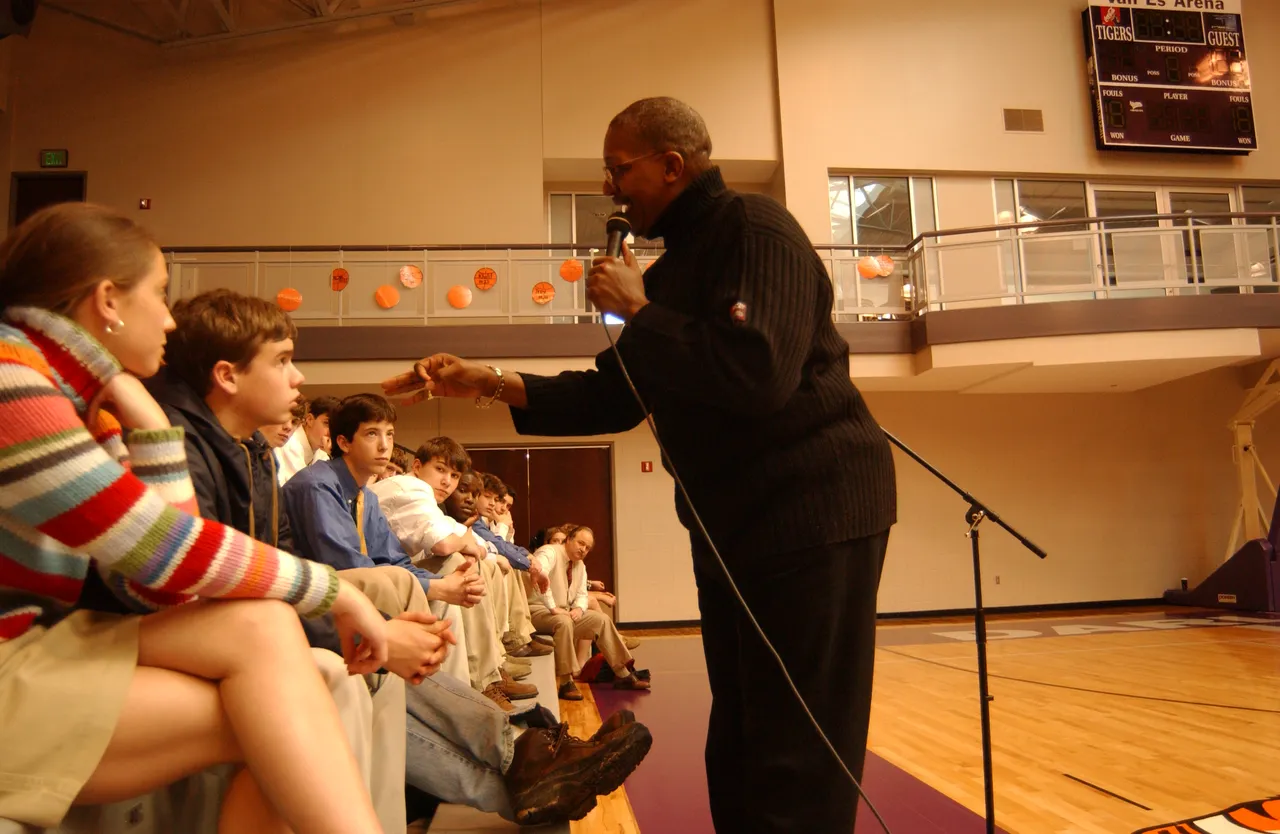
Other initiatives to discourage drug use at Darlington are already underway. Milton Creagh, nationally known drug education and prevention specialist returned to Rome this winter to deliver his hard-hitting message about the negative impact of alcohol, tobacco, and other drugs. He made a special presentation to Darlington’s Middle and Upper School parents and students on Feb. 1, in the Van Es Arena of the Huffman Memorial Athletic Center.
Creagh has been active on the public speaking circuit since the age of 17. After graduating with honors from Bethune-Cookman College in Daytona Beach, Fla., he has been given many honors and awards for his work with young people, including hosting two critically acclaimed, prime time, public broadcasting specials, a teen series, and a teen dance/talk show series, as well as a videotape training program. He is also the creator of the Parent’s Resource Institute for Drug Education (PRIDE).
Creagh opened his presentation by sharing with the audience what was cool when he was a teenager, the same things that are cool today; i.e., dress, talk, walk, and vehicle driven. He noted that, while his father did not let him have all the cool things he thought he needed, he still managed to do well in basketball. “Don’t be so worried about being cool,” he encouraged students.
“The world is scary,” he acknowledged and gave statistics to illustrate that fact:
·The number one cause of death among white male and Asian teenagers is drug or alcohol related accidents.
·In over 90 percent of the cases, young people, age 12-22, drown, not because they can’t swim, but because they are drunk.
·The number one cause of death among black and Hispanic males, age 12-24, is murder.
·Murder is currently the number two cause of death in white males and is predicted to soon become the number one cause.
·These deaths are not about racism, however. Typically the murders are committed by young people of the victim’s own race, two to three years older, who know the victim and are usually under the influence of alcohol.
·One out of four females is going to be sexually assaulted, molested, or raped before she is 18 and usually the boy or the girl or both are under the influence of alcohol or drugs. The boy is usually someone the girl knows or is dating.
·One out of two females is going to be physically abused by a boyfriend or husband under the influence of alcohol.
In case his audience members might be deluding themselves that these problems happen to other people and not to them or their family, Creagh ended his presentation on a dramatic note. He asked people to stand and remain standing if the following statements applied to them or to someone in their family:
·They know kids who are already drinking. (Many stood up.)
·They know someone who has been sexually assaulted. (A significant number stood.)
·Someone in the family is divorced because of a drinking or drug problem. (At least a couple dozen stood.)
·Someone in the family has been in jail because of drugs or alcohol. (At least 50 hands stood.)
·A family member died because of drug, alcohol, or gang-related reasons. (Again at least 50 stood.)
·A family member died because of a tobacco-related disease.
After the last statement, ninety percent of the audience was standing. All ages, genders, races, and nationalities were represented—a human exclamation point at the end of a dramatic presentation. Creagh’s last statement summarized his presentation: “It has little to do with decisions you’ll make 20 years from now. It has everything to do with the decisions you make right now.”
“I felt we needed to agree as a community that random drug testing is necessary,” David Hicks said. However, despite the House Senate’s conscientious work, the proposal was defeated again during a vote taken this fall. Per the proposal’s requirements, random drug testing will not be presented for a vote again for three years, after all current students have graduated, so that a new group of students can consider the idea.
“Random drug testing is a bold initiative for a private school and more radical than most students and faculty unfortunately felt they could accept,” Hicks explained. “Besides, incidents of known drug use have decreased significantly in the past few years, perhaps due to the success of the House system, so people may believe there is less reason for random drug testing.”
In a presentation to the Board of Trustees during its winter meeting, Jill Pate, director of student counseling, presented an overview of next steps that the faculty and administration are taking to discourage drug use.
“Students were concerned that random drug testing would hurt the School’s image. Some also found giving urine samples embarrassing and thought that having students taken for testing during school would be disruptive to class work,” Pate said. “Some faculty members expressed their concern that the warm and caring relationships between faculty and students would be affected negatively if students feel that they are being regularly tested for drugs. Concerns about false positives and invading students’ privacy were also expressed.”
“Regardless, the faculty is totally committed to finding other ways of addressing the issue of drugs. In our in-service faculty day after the Christmas, all faculty members were divided into 12 groups to brainstorm ideas of how we eliminate drug use among our students,” Pate said.
She described the function of the Student Support Team (SST), a program in which students and faculty can refer any student exhibiting unusual or negative behavior to one of the 12 adult SST members. Fourteen students also serve on SST.
All information about a referred student is completely confidential and kept within SST. An adult SST member visits the student who has been referred to express concern. A student who has been using drugs is asked to sign a no-use policy and is tested for drugs on a regular basis for the rest of the time he or she remains at Darlington.
“Referrals to SST have increased dramatically this winter,” Pate noted. The group is taking proactive steps to help faculty and students understand the positive role SST plays in intervention. For example, a “Question of the Week” is broadcast e-mailed to all Upper School faculty and students to increase awareness of SST.
Other initiatives to discourage drug use at Darlington are already underway. Milton Creagh, nationally known drug education and prevention specialist returned to Rome this winter to deliver his hard-hitting message about the negative impact of alcohol, tobacco, and other drugs. He made a special presentation to Darlington’s Middle and Upper School parents and students on Feb. 1, in the Van Es Arena of the Huffman Memorial Athletic Center.
Creagh has been active on the public speaking circuit since the age of 17. After graduating with honors from Bethune-Cookman College in Daytona Beach, Fla., he has been given many honors and awards for his work with young people, including hosting two critically acclaimed, prime time, public broadcasting specials, a teen series, and a teen dance/talk show series, as well as a videotape training program. He is also the creator of the Parent’s Resource Institute for Drug Education (PRIDE).
Creagh opened his presentation by sharing with the audience what was cool when he was a teenager, the same things that are cool today; i.e., dress, talk, walk, and vehicle driven. He noted that, while his father did not let him have all the cool things he thought he needed, he still managed to do well in basketball. “Don’t be so worried about being cool,” he encouraged students.
“The world is scary,” he acknowledged and gave statistics to illustrate that fact:
·The number one cause of death among white male and Asian teenagers is drug or alcohol related accidents.
·In over 90 percent of the cases, young people, age 12-22, drown, not because they can’t swim, but because they are drunk.
·The number one cause of death among black and Hispanic males, age 12-24, is murder.
·Murder is currently the number two cause of death in white males and is predicted to soon become the number one cause.
·These deaths are not about racism, however. Typically the murders are committed by young people of the victim’s own race, two to three years older, who know the victim and are usually under the influence of alcohol.
·One out of four females is going to be sexually assaulted, molested, or raped before she is 18 and usually the boy or the girl or both are under the influence of alcohol or drugs. The boy is usually someone the girl knows or is dating.
·One out of two females is going to be physically abused by a boyfriend or husband under the influence of alcohol.
In case his audience members might be deluding themselves that these problems happen to other people and not to them or their family, Creagh ended his presentation on a dramatic note. He asked people to stand and remain standing if the following statements applied to them or to someone in their family:
·They know kids who are already drinking. (Many stood up.)
·They know someone who has been sexually assaulted. (A significant number stood.)
·Someone in the family is divorced because of a drinking or drug problem. (At least a couple dozen stood.)
·Someone in the family has been in jail because of drugs or alcohol. (At least 50 hands stood.)
·A family member died because of drug, alcohol, or gang-related reasons. (Again at least 50 stood.)
·A family member died because of a tobacco-related disease.
After the last statement, ninety percent of the audience was standing. All ages, genders, races, and nationalities were represented—a human exclamation point at the end of a dramatic presentation. Creagh’s last statement summarized his presentation: “It has little to do with decisions you’ll make 20 years from now. It has everything to do with the decisions you make right now.”