NewsUpper SchoolFaculty/StaffAlumniAdvancementAcademicsFine Arts
Academics, alumni blend in art
Apr 6, 2001 8:00 AM
By Stefan Eady - Faculty
by David Powell, Darlington English department chair and Thatcher Chair of English
American poet Wallace Stevens once said that “a poem should resist the intellect almost successfully.” During my own high school and college days, I felt that most poems resisted my intellect with complete success. I ground my teeth in frustration every time a teacher asked me to look at a poem and “tell what it meant.” If the poem were a puzzle to be decoded, I thought, who cared “what it meant?” Modernist poetry, especially, seemed a conspiracy of scheming intellectuals who were determined to baffle me.
Over the years, and almost against my will, snatches of modernist imagery got stuck in my head and would surprise me with their aptness. Stuck in traffic with other bleary-eyed commuters, I would think of Eliot’s “hollow men.” TV pundits would recall Moore’s “immovable critic twitching his skin like a horse/ that feels a flea.” Apparently these poems had been “almost successful” in resisting my intellect, leaving behind fragments for which experience supplied a meaning.
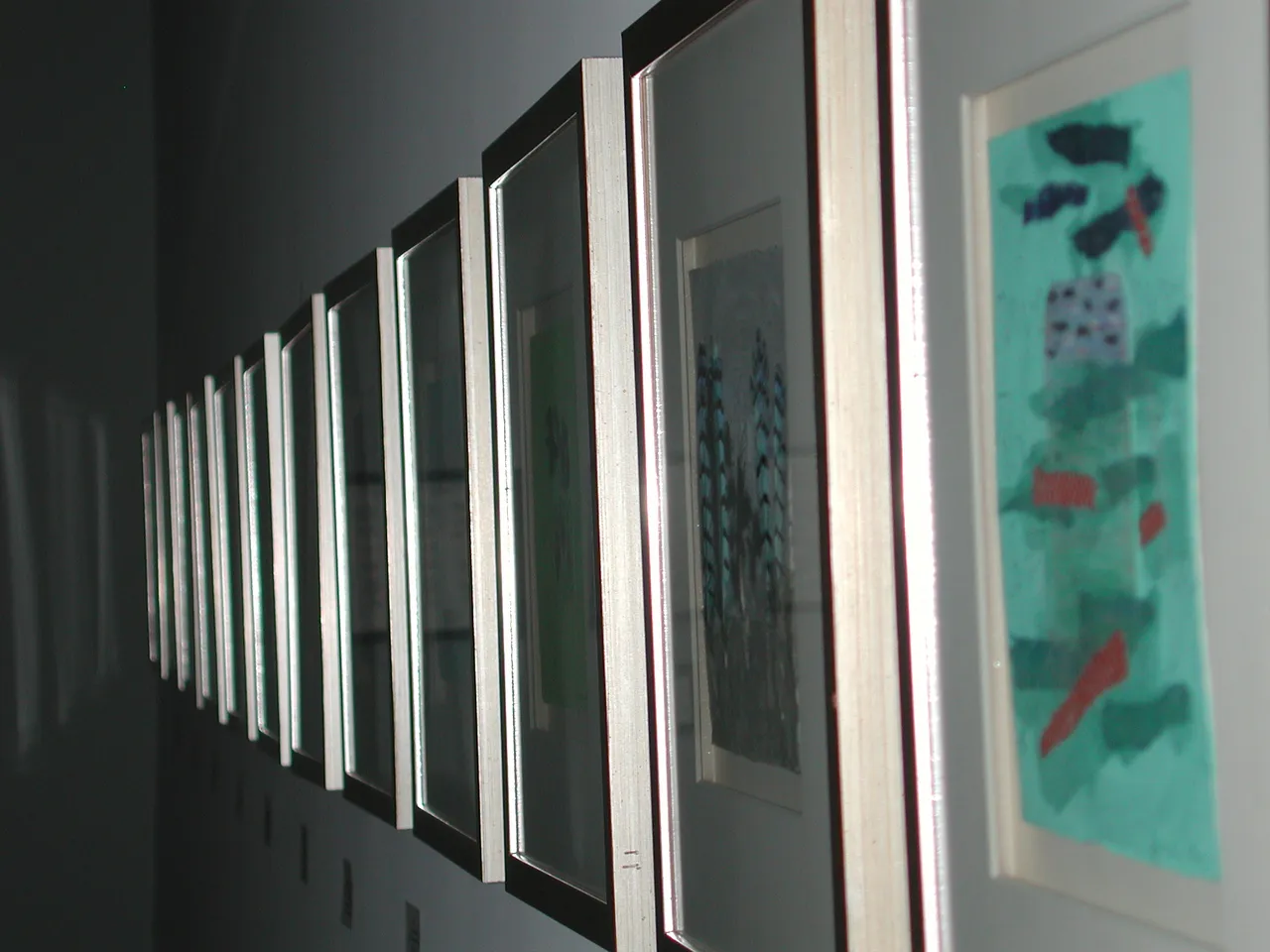
So when George Johnson ’54 called about seeing Beverly Key’s art work based on Stevens’ poem “Thirteen ways of Looking at a Blackbird,” I was eager to see how the artist had responded to these enigmatic fragments. Johnson, vice chair of the board of trustees, had been struck by the uniqueness of Key’s work and called the School, suggesting that we also view it and wondering if such a work would be good for students to see and think about. Wright Ledbetter, gift officer for capital giving, and I both had a chance to see it, and were enthusiastic about this bringing together of literary and visual art. Mr. and Mrs. Johnson’s gift to the School of Key’s artwork has proved a wonderful opportunity for students to explore connections between modernist poetry, contemporary visual art, and their own perceptions about art and experience.
Wallace Stevens’ poem embodies the modernist technique of focusing on fragments of language to express moments of perception which are fleeting, but in which compelling bits of thought and feeling become attached to concrete objects, actions, animals, and events. These fragments become all important in modernist poetry. They become the connecting points between writer and reader, between poet and audience. If I can’t know Wallace Stevens’ exact thoughts, I can connect to the image of icicles in the long window, or of a blackbird whirling in autumn winds or sitting in cedar-limbs.
Beverly Key chose to portray her perceptions of Stevens’ poem through visual media. My thought was that my students could encounter Stevens’ poem, then Key’s artwork, then articulate what happened in their own minds during these encounters. After a brief introduction to modernism, we spent a day exploring the poem by itself, playing with possibilities of meaning and sharing our perceptions about it. Then we spent two days looking at Key’s visual response to the poem, slowly gathering our initial reactions into coherent statements about reading the poem and seeing the artwork. The essay assignment was wide open: figure out an approach to writing about your experience with the poem and artwork.
Responses were wonderfully varied. Some students focused on the series of stanzas and pictures as a whole, though most chose to focus in on one or two stanzas/pictures which especially appealed to them. Some wrote about the impact of colors and textures, some about the themes of the piece, but all explored the double experience of bringing their perceptions to the artwork. It was a refreshing chance to multiply meanings rather than restrict them, quite an appropriate response to a poem which shows us that a single image, the blackbird, can be seen in thirteen different ways. Several of the essays are posted on the School’s Web site so that you can enjoy the insights of the students. I encourage you to enjoy these essays, and also to visit the School library to see Key’s artwork.
American poet Wallace Stevens once said that “a poem should resist the intellect almost successfully.” During my own high school and college days, I felt that most poems resisted my intellect with complete success. I ground my teeth in frustration every time a teacher asked me to look at a poem and “tell what it meant.” If the poem were a puzzle to be decoded, I thought, who cared “what it meant?” Modernist poetry, especially, seemed a conspiracy of scheming intellectuals who were determined to baffle me.
Over the years, and almost against my will, snatches of modernist imagery got stuck in my head and would surprise me with their aptness. Stuck in traffic with other bleary-eyed commuters, I would think of Eliot’s “hollow men.” TV pundits would recall Moore’s “immovable critic twitching his skin like a horse/ that feels a flea.” Apparently these poems had been “almost successful” in resisting my intellect, leaving behind fragments for which experience supplied a meaning.
So when George Johnson ’54 called about seeing Beverly Key’s art work based on Stevens’ poem “Thirteen ways of Looking at a Blackbird,” I was eager to see how the artist had responded to these enigmatic fragments. Johnson, vice chair of the board of trustees, had been struck by the uniqueness of Key’s work and called the School, suggesting that we also view it and wondering if such a work would be good for students to see and think about. Wright Ledbetter, gift officer for capital giving, and I both had a chance to see it, and were enthusiastic about this bringing together of literary and visual art. Mr. and Mrs. Johnson’s gift to the School of Key’s artwork has proved a wonderful opportunity for students to explore connections between modernist poetry, contemporary visual art, and their own perceptions about art and experience.
Wallace Stevens’ poem embodies the modernist technique of focusing on fragments of language to express moments of perception which are fleeting, but in which compelling bits of thought and feeling become attached to concrete objects, actions, animals, and events. These fragments become all important in modernist poetry. They become the connecting points between writer and reader, between poet and audience. If I can’t know Wallace Stevens’ exact thoughts, I can connect to the image of icicles in the long window, or of a blackbird whirling in autumn winds or sitting in cedar-limbs.
Beverly Key chose to portray her perceptions of Stevens’ poem through visual media. My thought was that my students could encounter Stevens’ poem, then Key’s artwork, then articulate what happened in their own minds during these encounters. After a brief introduction to modernism, we spent a day exploring the poem by itself, playing with possibilities of meaning and sharing our perceptions about it. Then we spent two days looking at Key’s visual response to the poem, slowly gathering our initial reactions into coherent statements about reading the poem and seeing the artwork. The essay assignment was wide open: figure out an approach to writing about your experience with the poem and artwork.
Responses were wonderfully varied. Some students focused on the series of stanzas and pictures as a whole, though most chose to focus in on one or two stanzas/pictures which especially appealed to them. Some wrote about the impact of colors and textures, some about the themes of the piece, but all explored the double experience of bringing their perceptions to the artwork. It was a refreshing chance to multiply meanings rather than restrict them, quite an appropriate response to a poem which shows us that a single image, the blackbird, can be seen in thirteen different ways. Several of the essays are posted on the School’s Web site so that you can enjoy the insights of the students. I encourage you to enjoy these essays, and also to visit the School library to see Key’s artwork.