Darlington School
Arts

Instrumental Music


At Darlington, you will experience more music than you ever thought possible. That’s because our instrumental music offerings go far beyond your typical band and orchestra program.

Our students start learning about music in pre-K, and through Orff instruction they begin to grasp concepts like rhythm and structure. Beginning in first grade, and sometimes earlier, they are introduced to string instruments. As their years of learning accumulate, more advanced students are invited to participate in the Lower School Orchestra. Along the way, some may also decide to join the Lower School Band in fourth grade. Beginning string students are accepted no matter what grade they might enter.

In the Middle School, string, wind and percussion instruments share a class and become a full orchestra. This is one of the youngest full orchestra ensembles in the nation. Beginners are welcome. Middle School Jazz Band is an after-school offering that is also open to all students and all instruments.

At the Upper School, Orchestra, Wind Ensemble and Guitar Ensemble are separate classes and often, select small ensembles are built within the same class or from a different class. Opportunities abound beyond typical classroom boundaries. For example, Orchestra students sometimes accompany the Guitar Ensemble. Wind students participate in select orchestral pieces. Pianists join the Wind Ensemble and Orchestra. Instrumental choirs perform chamber repertoire, and sometimes Orchestra members participate in Drum Line. Jazz Band is an after-school offering open by audition/invitation.

In addition to performing opportunities on and off campus with Darlington’s instrumental ensembles, members of these groups participate in Georgia Music Educators Association (GMEA) district and state-level activities and Georgia Independent Schools Association (GISA) choral events.

For more about the specific instrumental offerings at each of Darlington’s three divisions, please read below.

Lower School


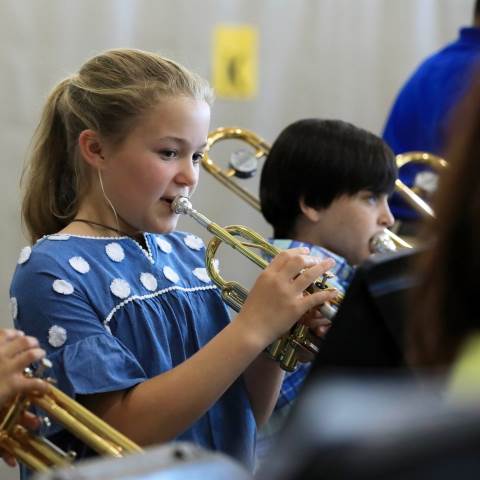
Band: Starting in the fourth grade, students can choose from the full gamut of Wind and Percussion instruments. From flute to tuba, students excel musically through daily study. Each year, the class has a slightly different dynamic; therefore, we do not adhere to a strict method or etude book. Students are instructed on care of instrument, music reading and independence, and skills for successful playing of the instrument. All music is arranged specifically for each students’ skill level, which allows for an individualized pace of advancement. Harmony is introduced early through specialized instrumental arrangements.

Keyboard: The Lower School uses the Yamaha MIE Lab for keyboard instruction in grades 2-4. Students experience hands-on instruction in music reading and keyboard skills to help them become familiar with different styles of music. They also begin to build their ongoing music vocabulary.

Strings: Violin, viola and cello are offered in a group setting for students in grades 1-4. Students receive instruction for reading music and string techniques. The string classes perform at least four times during the school year and end each year with a Battle of the Bands experience to showcase their accomplishments for the year. Within the Strings Program, each grade level is considered a separate ensemble. Beginners are taught as a separate group until they are able to join the more experienced players later in the year.

After-School String Orchestra: For the more advanced string players, we offer an after-school String Orchestra. This does not take the place of regular Strings class, but is instead designed to supplement teaching for the more advanced students.

Middle School


5th and 6th Grade Concert Band: Concert Band is open to students who play woodwind, brass or percussion instruments. They are introduced to proper harmony through the study of chorales and marches. By studying historical and contemporary composers, students explore techniques of sectional playing (support, intonation, blending tone quality) and band-specific literature. They also begin to expand their aural awareness through the introduction of basic intonation and balance/blend exercises.

5th and 6th Grade String Ensemble: String Orchestra is open to students who play violin, viola, cello or bass. Members are introduced to the classical and contemporary music as well as technical exercises. As their skills progress, they will begin to explore repertoire beyond the beginning methods, though studies will continue to focus on technical exercises and sound-building etudes/chorales. Students also begin to expand their aural awareness through the introduction of basic intonation and balance/blend exercises.

7th and 8th Grade Orchestra: The Orchestra is the most advanced instrumental group at the Middle School, and is the center of the instrumental music program. It is a combined effort from the Concert Band and String Ensemble. This group performs several times throughout the year and travels to a festival in the spring.

  • Concert Band: Wind and percussion members of the Middle School Orchestra are introduced to proper harmony technique through the study of chorales, marches and popular tunes from various nationalistic styles. By sometimes playing separately from the strings, students are exposed to the skills of sectional playing (breath support, intonation, blending tone quality). Students also begin to expand their aural awareness at an accelerated pace.

  • String Ensemble: String players are introduced to the proper concept of sectional performance as their skills progress. Students focus on technical exercises, sound-building etudes and chorales, while exploring diverse repertoire beyond the Suzuki method in order to further develop proper sound, intonation and technique. The more advanced students may audition for the Middle School Chamber Ensemble, which includes Concert Band instruments.

Instrumental Methods is beginning band class but is open to beginning and advanced players, though instruction is geared towards the beginning student. A beginning student should attend this class if he or she would like to learn to perform on a wind or percussion instrument, and an advanced student (including piano) may attend this class if he or she would like extra practice time beyond Orchestra.

After-School Jazz Band: Designed to allow all instrumental students access to jazz music, this ensemble is open to more than just the typical jazz band instruments. By teaching improvisation skills and theory, students perform in a setting in which they are allowed to help create the music.

Upper School


Wind Ensemble: Students will find that the Wind Ensemble is extremely versatile. This award-winning group plays music from the standard concert and symphonic repertoire (American, German, French, Russian styles), as well as more progressive Eastern arrangements (Yiruma, Hisaishi). Technical studies continue, but theoretical training begins in preparation for Senior AP Theory.

  • Stadium Band: The Darlington Tiger Band is the most visible performing group on campus. All Wind Ensemble members participate in Stadium Band, and the music is fast and fun.

  • Instrumental Choirs: For special events, a woodwind, percussion, or brass group will often be chosen to represent the instrumental department. These groups are formed by director selection.

  • Chamber Ensemble: The Darlington Chamber Ensembles are mixed wind and percussion ensembles. Open by audition or director selection.

  • Solo Performance: Wind players team up with piano accompanists to perform pieces from the solo repertoire. This is very helpful for those that wish to compete for college scholarships.

  • Piano Society: Pianists are an integral part of the instrumental department and, depending on proficiency, are sometimes asked to perform dual roles as soloist and accompanist.

Orchestra: This class is for all string players and accommodates all skill levels by allowing participation in the String Ensemble without audition; however, The Darlington String Quartet is by audition or placement by established proficiency. Repertoire covers the major symphonic styles (German, French, Italian, Russian) as well as contemporary Eastern arrangements.

  • String Ensemble: This is an all-string group that is open to all participants. Those who do not pass the Quartet audition will participate in this ensemble. Repertoire is chosen or arranged to accommodate each player’s individual skill level.

  • String Quartet: Open by audition only, the Darlington String Quartet performances are not to be missed. In the case of a tie or several overly qualified students, parts will be decided by rotation or repertoire will shift to early Italian and German Sinfonia repertoire.

  • Solo Performance: String players team up with piano accompanists to perform pieces from the solo repertoire. This is very helpful for those that wish to compete for college scholarships.

  • Piano Society: Pianists are an integral part of the instrumental department and, depending on proficiency, are sometimes asked to perform dual roles as soloist and accompanist.

Guitar Ensemble: Darlington’s Guitar Ensemble is designed for intermediate to advanced guitarists who want to learn and understand how music functions. In ensemble class, students learn to read music (tab, chord changes and notation), perform as a group, improvise as a soloist, and understand basic theory. By covering a variety of musical styles, each student will ultimately be able to transfer the skill acquired in class to any and all types of music outside of class.

  • Solo Artists: Many times, guitarists (especially vocal/guitarists) participate in the class by taking a separate track inside the class and choose to pursue the “solo artist” path. This can also apply to those that are more inclined to solo classical repertoire.

AP Music Theory: This course develops a student’s ability to recognize, understand, and describe the basic materials and processes of music that are heard or presented in a score. The achievement of these goals is best approached by initially addressing the fundamental aural, analytical, and compositional skills using both listening and written exercises. Students enrolled in this course are required to take the AP Exam. Prerequisite: The student’s ability to read and write musical notation is fundamental. It is also assumed that the student has acquired (or is acquiring) at least basic performance skills in voice or on an instrument.

After-School Jazz Band: Darlington’s Jazz Combo is run like a university program. The group performs an entire album from the standard jazz repertoire and special arrangements are made to accommodate instrumentation


Follow us on Facebook Georgia GOAL Scholarship Program Alumni Weekend 2010

QUICK LINKS

       
© 1997-2010, Darlington School | 1014 Cave Spring Road, Rome GA 30161 | 1-800-36-TIGER | Directions | Contact Us | Privacy Policies