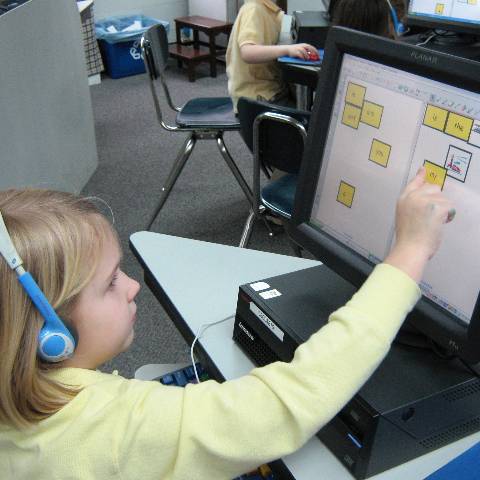
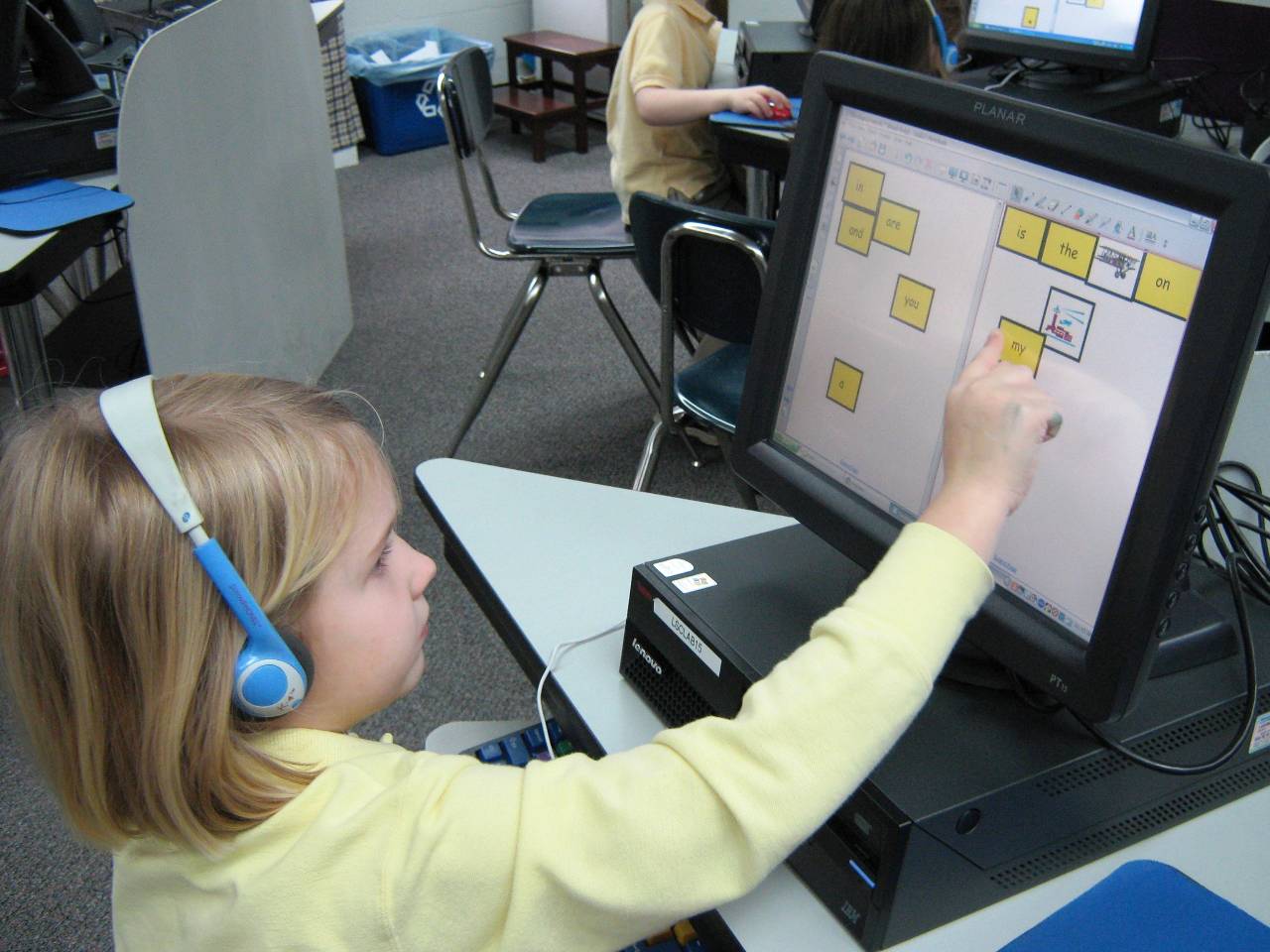
Darlington’s Lower School has received $10,000 worth of touch screen monitors for participating in a pilot assessment program with the Educational Records Bureau and Children’s Progress.
“I am honored to be coordinating this effort at the Lower School,” said computer instructor Patricia Ayer. “This fall, we began year two of the two-year pilot program. I think it’s neat that our children get to participate in something that’s going to help other people. It speaks volumes about our school and our students that the organization felt that our population would be conducive to this sort of endeavor.”
Darlington is one of several independent schools throughout the country selected to test the assessment program with students in pre-kindergarten through first grade. Unlike previous studies in which only a child’s analytic skills have been tested, this program examines each child’s unique strengths in analytical, creative and practical abilities. Because the assessment program takes into account the strengths of all types of learners, the data collected can be used in independent school admissions and placement decisions to ensure that a student will be able to thrive in his or her educational environment.
“The goal is to get a comprehensive understanding of how different children learn,” said Christopher Camacho, director of research at Children’s Progress.
Darlington students have already been using the Web-based assessment tool, Children’s Progress, as a precursor to their ERB testing for the past two years.
“Children’s Progress is a great tool to help students prepare for the ERB,” Ayer said. “A voice reads to the children over their headsets, and questions are asked in a format the teacher would use when he or she gave the real standardized test in the classroom. But instead of writing, children would use the mouse to select the correct answer. The program compiles data and gives the teacher information on each child and on the class as a whole. That way, the teacher can pinpoint weaknesses and strong points and know whether to go back and re-teach a particular concept to an individual or to the entire class.”
In the pilot assessment program, students use a touch screen instead of a mouse to select the correct answer – or answers. Darlington students in pre-kindergarten through first grade have completed six assessments, known as “releases,” since February.
“The pilot assessments are even more elaborate and interactive than the Children’s Progress programs we have been using for the past two years,” Ayer said. “The graphics are beautiful. This was also the first time the children could select more than one answer to a question. Their little eyes got so big when they figured that out; they were so excited that a new thing was added to their assessment. Our students are having a lot of fun with this. In their minds, it’s like a computer game, but they are actually learning at the same time!”
Ayer added that the touch screens have been a great addition to the computer lab, and even students who are not participating in the pilot program are enjoying them. “Our second- through fourth-graders have loved having the touch screens because they are applicable to any program we have,” she said. “It’s like having 20 mini-SMART Boards in the lab!”